

- Build and protect a defensible market position
- Align leadership, motivate employees, and improve culture
- Guide product pipeline and innovation decisions
- Improve effectiveness of marketing and sales
- Increase consumer trust, loyalty, and advocacy
- Improve brand equity, company value, and transaction readiness
— Philippe Chelle, CEO at Alzoo
🤑 Chewy posted a record profit quarter and still cut its full-year sales outlook
💉 A twice-yearly itch shot just matched Cytopoint in a head-to-head study
🥳 Activist pressure just closed one of the country's largest research dog breeders
🤝 One of pet's biggest consolidators just hired two M&A veterans to run its portfolio
🏫 Dog kindergartens are the latest sign China's $46B pet market means business
💨 ButcherBox just spun its pet food line into a standalone brand called DASH Dog Food

A pet owner can tell you the price of a 24-pound bag of kibble to the penny before it ships. She cannot tell you what her dog's dental will cost until the dog is already under anesthesia and the vet is counting extractions.
One of those markets runs on posted prices. The other runs on a number you only learn after you have agreed to pay it.
That gap is not an accident of an old-fashioned industry slowly catching up. It is a choice, and a recent study makes the scale of the choice hard to look away from.
When researchers checked 157 small-animal clinic websites across eight states, only three of them posted any service prices at all (under 2%). In a category where owners now spend an estimated $41B a year on veterinary care, the price is almost never on the wall.

The convenient story is that vet medicine is too variable to price in advance, that every animal is a unique case and a posted number would be a lie. That story is half true. It is true for the surgical and diagnostic tail, the impacted molar, the mass that turns out to be something. It is false for most of what walks through the door, and the clinics now proving it false are the most interesting thing happening in the category.
The Opacity Is Selective, Which Is The Whole Tell
Here is the part the variability defense leaves out. A large share of routine veterinary work is as standardizable as an oil change. A wellness exam. The core vaccine series. A heartworm test, a fecal, a FeLV/FIV snap test, a 4DX panel, all of them near-fixed-cost point-of-care kits. A nail trim. An anal gland expression. A spay or a neuter, which is the same procedure at a nonprofit clinic and a private hospital. A routine dental scale-and-polish, where the base service barely moves with the size of the dog.
These are SKUs.
They are comparable across clinics in exactly the way a bag of food is comparable across retailers. The genuinely unpredictable work, the extractions that can run $78 to $130 a tooth before anesthesia and radiographs, the periodontal grading you cannot see until the animal is sedated, the intra-operative surprise, is real and really hard to quote. The industry's standard move is to fold the knowable base into the unknowable tail and then decline to quote either one.
You can watch the cost of that opacity in how owners talk.
A homestead creator with a verified following posted last month that she had no idea vet pricing could vary this much until she started calling around. One clinic quoted her over $1,100 to neuter her dog. Another quoted $700. One came in at $200 but was booked solid.
She drove an hour to a spay-neuter clinic and paid $300. Same procedure. A 5x spread inside one metro, invisible until she made the calls herself.
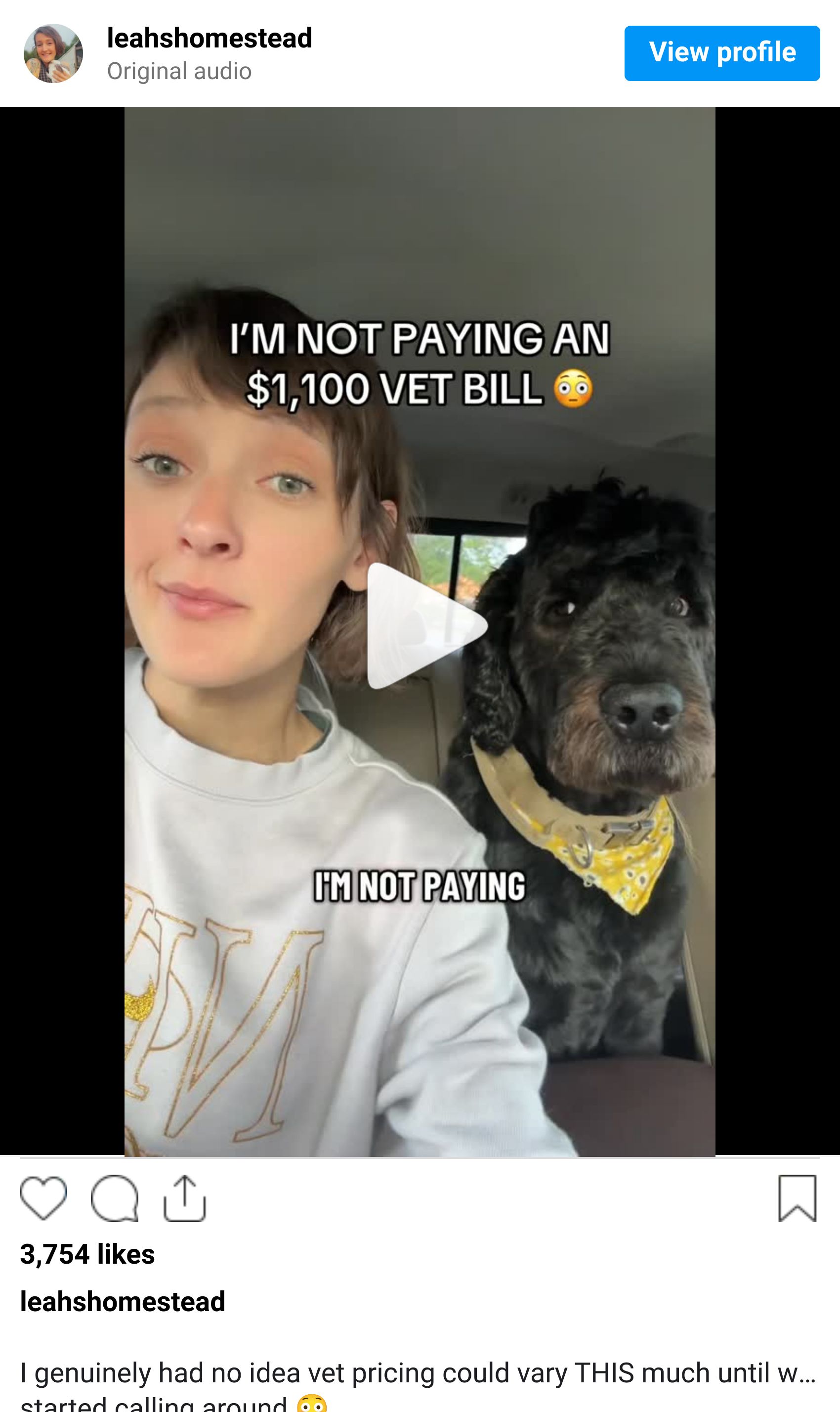
The takeaway is not that one of those clinics was gouging. It is that the owner had to run her own private market-research project to find a number, and most owners will not.
They book the closest clinic, get the exam, and only learn the real cost when they are standing at the counter being walked through options, or when the vet finds something mid-procedure and comes back with a second quote for sedation or an extraction. The grievance in the pet forums is rarely that care costs money. It is that the number arrives after the decision is already in motion, not before it. That is a consent problem dressed up as a pricing problem, and the survey data backs it.
In the PetSmart Charities and Gallup State of Pet Care study, 52% of owners said they skipped or declined needed care in the past year, and among those who declined for cost, 73% said they were never offered a more affordable option.
The conversation simply never happened.
Why A Dark Price Tag Is Good Business
The defense of opacity is not stupid, and it deserves a fair hearing. The surgical tail genuinely cannot be quoted blind, and a posted number invites a fight when the findings change the plan.
Wellness care is often priced near cost, with the practice leaning on diagnostics, dentistry, and surgery margins to stay open, so posting the commodity prices invites a race to the bottom on exactly the visits that build a client relationship. Vets argue, not unreasonably, that price-shopping pushes owners toward the cheapest option over the right one. And an unposted price preserves a vet's room to quietly discount for a client who is struggling, which many do.
All real. All also a near-perfect description of what private equity benefits from. Corporate and PE ownership of US clinics has climbed from a low single-digit share in 2011 toward roughly half the market by some estimates today, though no authoritative national census of clinic ownership exists, and that absence is itself part of the problem. What is documented is the money.
PitchBook data cited by The Atlantic puts private-equity investment in the sector at $51.6B from 2017 through 2023, with billions more the following year. The roll-up model runs on standardized protocols, revenue targets, and cross-selling owned diagnostics, and all of it works better when the customer cannot easily compare prices. That does not make opacity a conspiracy. It makes it a structure that happens to serve the clinical argument and the consolidator's economics at once, which is why it is so durable.
The FTC has taken note, forcing divestitures in a 2022 specialty-clinic deal over local competition concerns.
The most striking thing in the forums is not the complaining. It is the forensics.
In an r/Austin thread asking for independent, non-PE-owned vets, the original poster did not just ask for a good clinic. They listed the corporate owners to avoid by name, more than a dozen of them, Banfield and IVC and BluePearl and NVA and the rest, the way a shopper lists brands they have learned to distrust. Ninety-four upvotes, nearly two hundred comments.
Owners traded the name of a beloved local practice, then warned each other when a chain had quietly bought it and kept the old sign up. One described taking a cat in months later, not knowing the practice had changed hands, and realizing mid-visit that something was different.
This is playing out across the board. A Chicago owner posted that they wanted to switch to a locally owned, non-PE practice because they could not shake the feeling of being taken advantage of at their current vet, and were willing to drive for it. The replies were careful to manage expectations, the independents were not necessarily cheaper, but the posters preferred them anyway.
Tools have grown up around this instinct. Owners now circulate resources like pets.care, which exists specifically to help people understand and route around corporatization, and ownership databases like PrivateEquityVet.org, which maps which local-sounding clinic belongs to which parent company.
Two things have to be said at once.
The behavior is real and growing, owners are actively screening for ownership before they pick a vet. And the belief driving it, that acquisition raises prices and lowers care, is not something the data has established. We went looking for a rigorous US study isolating the price effect of corporate acquisition and did not find one. Neither did the FTC's public materials.
The perception is well documented, the causation is not, and the reason is simple. Without posted prices, there is almost nothing to measure a before-and-after against. The same opacity that makes owners suspicious is what makes the suspicion so hard to confirm or put to rest.
The Insurance You Cannot Leave
If unposted prices are the visible opacity, pet insurance is the structural one, and it is the most quietly damning piece of the whole picture.
Pet insurance is the rare consumer-insurance market that punishes the two things a rational shopper would do, switch carriers and hold the policy as the asset ages. The mechanism is the pre-existing condition. The moment a pet is diagnosed with anything, allergies, a limp, a lump, tartar, an off kidney value, that condition goes in the record, and any new insurer treats it as pre-existing and excludes it, usually permanently.
So the longer and more loyally you hold a policy, the more of your pet's accumulated conditions are welded to your current carrier. Switching means walking away from coverage for exactly the conditions most likely to generate a claim. You are not a customer who can leave. You are a hostage with a renewal notice.
It gets worse as the pet ages, which is to say exactly when you need it. Premiums rise at every renewal, and some carriers stop accepting new enrollments past a certain age entirely. Coverage narrows toward accident-only and high-deductible structures right as the high-need years arrive. The owner is least able to re-shop at the precise moment the premium spikes hardest.
The escalation is not abstract, and I can show you my own. I insured my pup Mapo, a healthy pittie mix, in 2022 at $41.53 a month. By 2024 the carrier sent a note that opened by reaffirming its promise to always charge a fair and accurate cost (whatever that means), then raised the monthly premium from $55.69 to $76.61.
The 2026 version of the same letter, same friendly preamble, moved it from $106.17 to $133.53. That is a healthy dog with one claim, more than tripling in four years. My pug, healthier on paper, costs even more, because breed risk is priced in ways I never see.
These increases are filed with state regulators, not negotiated by the policyholder, and the industry-wide trend matches the household one. Dog accident-and-illness premiums rose 11% year over year in 2024 on a national basis.


Email renewal on Mapo’s pet insurance
Set that against the insurance markets people know. Auto and home get re-underwritten fresh by any competitor every year, so re-shopping is the rational default and a clean record is portable and even rewarded.
ACA health insurance bans pre-existing exclusions outright and guarantees portability at open enrollment. Pet insurance inverts all of it. The medical history is portable only as a liability, switching forfeits earned coverage, and aging strictly worsens the terms. It is a one-way ratchet, and it interacts with opaque vet pricing in the hardest way, because neither the premium trajectory nor the underlying cost of care is knowable when you sign up.
The UK shows it does not have to work this way, at least not entirely.
British insurers also exclude pre-existing conditions, so that part is universal. But the dominant product there is lifetime cover, where a condition that develops while you are insured stays in the benefit pool year after year as long as you keep renewing without a break. A UK owner whose dog develops a chronic problem is not immediately abandoned the way a US owner often is, though switching carriers still means losing that coverage. It is not a free lunch.
Lifetime policies command higher premiums, and that continuity is a big reason UK uptake runs far ahead of ours, with roughly a quarter of UK dogs insured against a small fraction of that here. The point is not that one market is virtuous and the other is greedy. It is that product design, not nature, decides whether a sick pet is a customer you keep or a liability you shed.
You can hear the trap close in real time. Just a couple of weeks ago, in one Austin pet-owner FB group, a member whose senior dog had just been diagnosed with leukemia asked the group for affordable insurance recommendations. The replies delivered the news gently and unanimously. It is a pre-existing condition now. You would have needed the policy before the diagnosis. The math only works if you buy insurance for a problem your pet does not yet have, and most people do not think to insure against a catastrophe until it has already arrived.
With penetration at just 3.9% of US pets, most people are uninsured when the bill lands, and the door to coverage shuts on the way in.
Visits Are Down, And It Is Not A Mystery
Put the pieces together and the demand signal looks bad, but the reason is more interesting than the obvious one. Visits are falling, into a fifth straight year by the AVMA and Brakke numbers. The tempting read is that owners are broke and cost is chasing them away. The better data complicates that. A CATalyst Council white paper argues the decline is mostly structural, a demographic problem rather than a spending one, because the puppies that drive a decade of visits were never adopted.
New puppy clinical visits sit roughly 38% below their pre-pandemic baseline, and that shortfall locks in lower volume into the mid-2030s no matter what owners do next.
So price is not the main reason the waiting rooms are emptier. But it is doing something quieter and more relevant to this story. With fewer animals coming in, clinics have leaned on price to hold revenue up, and veterinary service inflation has run 51.4% since 2019 against 28.5% for all items. That lever works against the demographic one, because every increase hands a cost-sensitive owner another reason to skip the visit they were on the fence about.
You can see the deferral in what gets cut first. Owners drop diagnostics before anything else, the most commonly declined service at 22% in AVMA's owner survey, then preventive care.
When a household cannot price care in advance, cannot insure against it after the fact, and watches the cost climb every year, declining a recommendation is not irrational. It is budgeting under uncertainty, which is a miserable way to make a medical decision for an animal you love.
The Market Is Already Building The Workaround
The encouraging part is that the fix is not waiting on a regulator, and it is not going to come from one. The closest precedent, the federal hospital price-transparency rule that took effect in 2021, is a cautionary tale. It forced hospitals to post their prices, and most complied minimally, burying incomplete files until CMS tightened the format.
Through mid-2025, across thousands of reviews, CMS had issued only a couple dozen monetary penalties, and a mandate moved disclosure long before it moved prices. Veterinary medicine has no CMS, no federal lever at all.
Any transparency revolution here comes from competition or it does not come.
It is coming from competition. A cohort of newer clinics has made posted, predictable pricing the product. Modern Animal lists membership and pay-as-you-go exam prices openly, around $75 to $85 for a wellness exam depending on the city.
Small Door publishes a table of typical service ranges under a no-surprise-bills promise, $149 a year or about $135 a visit. Petfolk goes furthest, with a zip-code-gated price list that itemizes standard and member rates down to individual vaccines, diagnostics, dentals, and spay/neuter.
Chewy's clinics post a flat $79 sick exam and a $19.99 monthly membership, and Sploot runs the SplootPack membership with waived exams and posted discounts across three states.
Scrutinize the cohort, though, because what they prove is narrower than full transparency. These clinics post itemized menus, real ones, where an owner can compare an exam, a vaccine, a dental, or a neuter before booking, which is exactly what almost no traditional clinic does. But the posted prices stop where the standardizable menu stops. The exam, the shots, the routine cleaning all carry a number, and then the genuinely variable work, the extractions, the periodontal findings, the surgical complications, still gets quoted case by case once the animal is seen. That is not a knock on these brands. It is confirmation of the thesis. When the clinics most committed to posting prices can put a number on the front-end and not the tail, it tells you the front-end was always priceable and the tail genuinely is not. The transparency is real. It just maps precisely onto the line between the commodity menu and the bespoke one.
It is a genuine differentiator on trust. It is a marketing claim where it implies the whole menu is shoppable. And the reliance on financing like CareCredit across several of these brands is a quiet reminder of the same affordability strain driving everyone.
The sharper signal is the unbundling.
Pet dental is starting to split off from general veterinary medicine the way human dentistry and vision split from general medicine a century ago, a high-frequency, partly standardizable, prevention-oriented service peeling away into dedicated shops with fixed prices.
The UK's Luna, a vet-led, anesthesia-capable, fixed-price dental-only business, raised £700k to expand. In Austin, Calm Bite runs a cleaner, more aggressive version, non-anesthesia ultrasonic cleanings, one hour, fixed price, no sedation, openly billed as cosmetic rather than medical.
That distinction is the whole tension in the unbundling story. Calm Bite says plainly that it is not a veterinary service and that pets with disease should see a vet, and the American Veterinary Dental College considers anesthesia-free cleaning largely cosmetic because it cannot reach disease below the gumline.
The market is unbundling the visible, shoppable layer of dental care first, the commodity end, and leaving the genuine pathology to the vet and the anesthesia. Luna is the defensible full-stack version, Calm Bite the commodity one.
Both put a number on a service the rest of the industry still hides, which is the point.
What This Means For Anyone Selling Care
The owner has already changed. She calls around for a neuter price. She reads the footer to find out who owns her vet. She has learned that pet insurance is a door that locks behind her. The visit pipeline is thin for demographic reasons no clinic can fix, but the owners who are still showing up have been trained by the whole transaction to expect an ambush, and a trained customer defends herself by deferring the diagnostic and rescheduling the dental.
The clinics that win the next decade will be the ones that treat the posted price as the product, not a threat to margin. Not because a regulator will make them, there is no regulator coming, but because the standardizable two-thirds of the menu is now a competitive surface, and someone in every market is about to compete on it.
The honest version of the bespoke-care defense survives. The version that uses the genuine surgical tail as cover to keep the commodity front-end dark does not, because the customer has finally figured out the difference.


