

🧬 A gene therapy validated in blind dogs just won the Breakthrough Prize
👏 34,000 fewer dogs and cats killed in U.S. shelters last year
🚙 Stellantis just launched a pet accessories brand. You can buy dog gear at your Jeep dealership now.
🏭 Pet food's two biggest extrusion equipment brands are now one booth, one company, and one product line under JBT Marel
⚖ A goldendoodle died of DCM at 10 after years on Blue Buffalo grain-free. Now it's a class action
👀 Nashville K-9 has one of the wildest company trucks and an insane facility

In Aesop's reel for its pet line, an Afghan hound sits in a leather chair and watches herself in a mirror while a groomer brushes her coat down. Same gesture you've gotten from your own stylist before being asked what you want done.
The reel could be mistaken for any other Aesop campaign. That parallel is the whole story.
Over the weekend of International Pet Day, Aesop ran the in-store version of the ritual.
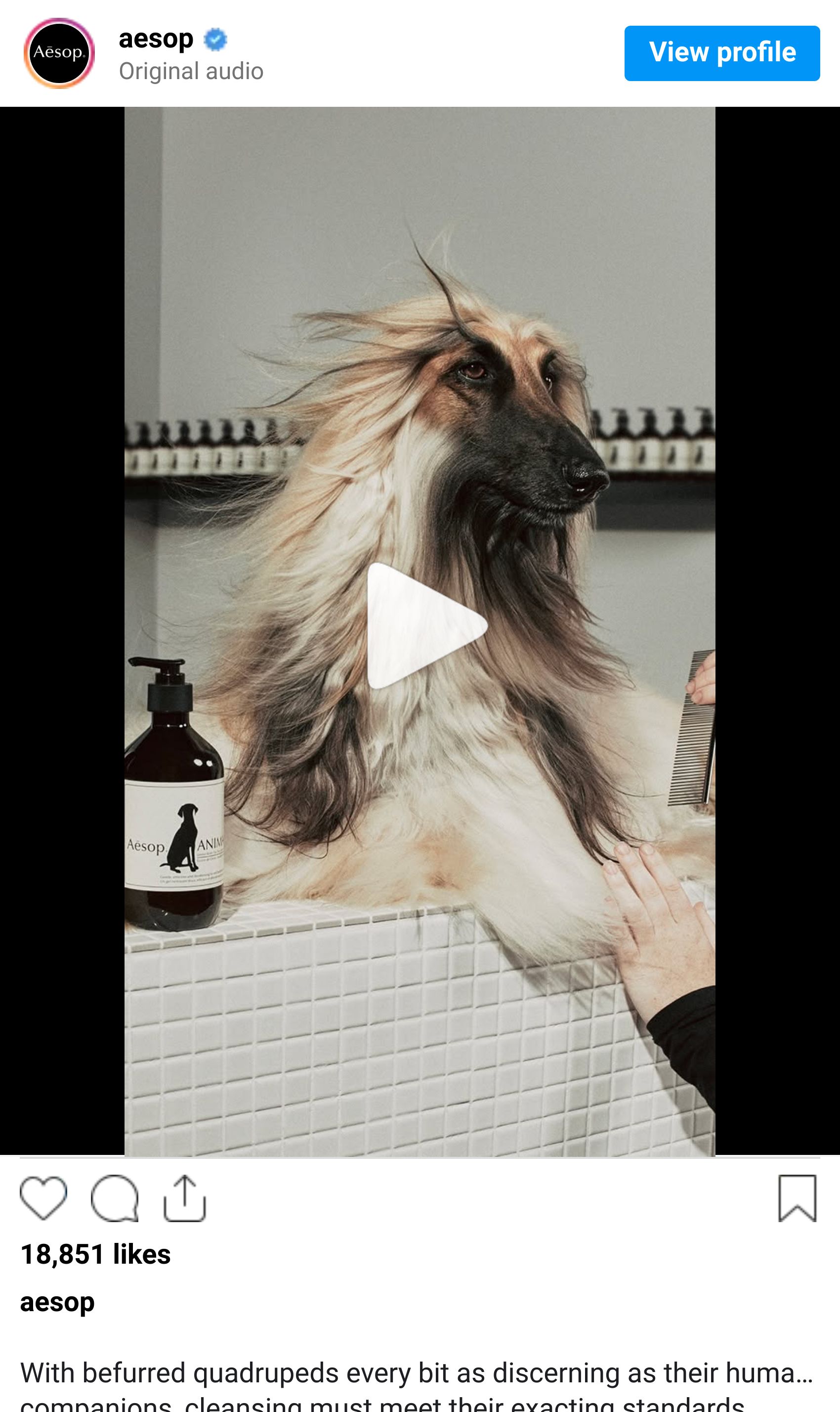
A service called Paw Parlour at four of its Australian flagships and twenty-two US stores.
Customers who spent $150 in person walked out with a custom bandana tied to their dog and a treat from Campfire Treats, the brand's US bakery partner.
The appointments were designed to center the pet, not the owner, and were run in the same register Aesop uses for its fragrance consultations.
Paw Parlour appears on the global store locator as a filter alongside Facial Appointments, Fragrance Armoire, and Private Consultation.
Whether that placement holds beyond the current activation is an open question, but the slotting alone tells you how the brand is thinking about this.
Pet got grouped with services, not with seasonal gifting.
For a brand that primarily sells hand cleanser to adults who subscribe to Monocle and Architectural Digest, that choice is a signal worth watching.
The campaign production reinforces it.
Aesop's storefronts are design objects, often collaborations with serious architects, and the brand applies the same discipline to its creative work. The pet reel runs at that tier.
The product at the center of the ritual is Aesop Animal, a 500ml amber bottle that retails for $48 in the United States.
It has been on shelves for at least twelve years, with beauty press reviewing it as far back as 2014.
Aesop didn't need to work hard at pet because the brand equity it had built in home, bath, and personal care was already doing the work.
The apothecary bet
Into The Gloss reviewed Aesop Animal in August 2014, two weeks after Aesop formally introduced it.
The same month, Malin + Goetz launched its Dog Shampoo, a $30 single SKU that has stayed a single SKU for twelve years.
Kiehl's Cuddly-Coat appeared a few years later.
Three prestige apothecary brands, three different continents, each made the same bet that human-grade personal care had a pet adjacency worth exactly one product.
For twelve years they were mostly right.
The market was small, the customer was wealthy and urban, and the shampoos sold slowly and quietly from store shelves that also held amber bottles of hand cleanser.
None of the three brands expanded the line.
None added a conditioner or a spray or a wipe. The thesis was proven in miniature and parked.
Then the temperature changed around them.
What $14,000 a year buys
In mid-March, The New York Times ran a piece about dog grooming costs that treated the category as an extension of human wellness.
Sam Cheow, a New Yorker with four Norwich terriers, spends roughly $11,000 a year on grooming and another $3,000 on hand-stripping.

Ruth Zaplin, in Washington DC, told the paper she pays between $500 and $700 a month for her one-year-old poodle Jasper, including a ten-hour session at a local grooming spa that ran $1,000.
The piece described blueberry masks applied around dogs' eyes and anti-aging peptide therapies marketed to older pets.
What the piece captured, and what's showing up across the category, is that grooming has been pulled into pet wellness.
It's no longer a hygiene line item.
It sits on the same mental shelf as food, supplements, and preventative care. That shift is what's pulling beauty-trained capital into pet.
In our recent interview with Jane Lauder, the former Estée Lauder executive who launched TAW Ventures in 2024 to invest in pet health and wellness, she made the overlap explicit.
Pet parents are now asking the same questions prestige beauty consumers started asking a decade ago.
What's in it. Does it work. Who's behind it.
The standards transfer from human beauty to pet. So does the capital behind them.
The US pet grooming products market is now worth roughly $5.2B and growing at a 5.4% CAGR through 2030.
The pace runs about one-and-a-half times faster than overall US CPG. It is still a fraction of the global human beauty category, which clears $600B.
What gets interesting is where the money has and hasn't moved since. Human beauty has produced a steady run of premium brand exits.
Pet grooming has been busy consolidating supply.
They didn’t coordinate, but they all showed up
Three types of brands are now entering at once. Each one is importing equity from somewhere other than pet.
The first wave is the native cohort, DTC brands built by founders whose last jobs were in beauty.
Biche, founded by Alexandra Pauly, the founding beauty editor at Highsnobiety, launched its pet line this year.
Its signature fragrance was co-created by a Givaudan senior perfumer and the founder of Arquiste, a niche fragrance house.
The line opens with a $50 Cloud Cleanser shampoo and a $60 Après Oil.

The brand raised a mid-six-figure pre-seed from Vicken Arslanian, who built and sold Commodity fragrance.
None of that reads like a pet startup. It reads like a fine fragrance brand that happens to wash dogs.
Lil Luv Dog launched in August 2025 with a $1M seed round and a founding team that includes Stephanie "Steph Shep" Suganami and Cara Santana Leto.
It became the first brand to earn EWG Verified Pet Grooming certification, a credential that did not exist in pet before this brand asked for it.
Dandylion, out of Toronto, was founded by Carolyn Chen, a former Bain consultant who previously built two clean-beauty brands.
Welltayl, founded by Brooklyn-based brand designer Ana Prodanovich (she also runs Studio Proda, a branding agency that's worked across fine jewelry, beauty, and healthcare), launched in October 2025 with EWG Verified, Leaping Bunny, and B Corp certifications.
Pride+Groom, the most established of the cohort, was founded in 2020 by four women that include Regina Haymes, a twenty-year Vogue and Marie Claire veteran, and Patricia Machado, a Brazilian-born chemical engineer. The brand has made Oprah's Favorite Things list every year since 2020.
The pattern is impossible to miss.
Every founder in this cohort came from beauty editorial, fashion and creative direction, clean-beauty brand-building, or the creator economy. None came up through the pet industry.
This is the same founder pattern that defined human beauty between 2014 and 2018, when Glossier, Drunk Elephant, The Ordinary, and Summer Fridays all emerged from publishing, skincare advocacy, and lifestyle media rather than the traditional personal care trade.

The second wave is adjacent CPG extension.
Mrs. Meyer's for Pets launched in March 2025 under SC Johnson, with six SKUs priced between $10 and $12 and distribution at PetSmart, Amazon, Target, and Grove Collaborative.
Its current campaign, anchored by creator Becca Tilley and an "Oopsurance" platform around pet messes, pulls the new line directly into the Mrs. Meyer's household-cleaning narrative.
Ouai Fur Bébé, a $32 dog shampoo sold alongside Ouai's human haircare in Sephora, has been on shelves since March 2021 under Procter & Gamble ownership.
Grove Collaborative's Good Fur launched in December 2021.
Burt's Bees for Pets, licensed through Clorox, quietly expanded its Prebiotics Collection in 2024 and 2025.
The pattern here is trust arbitrage.
None of these brands had to earn consumer credibility from scratch.
Consumers already know what Mrs. Meyer's smells like, what Ouai stands for, what Grove sells at checkout.
The pet extension borrows that equity for a new shelf.
The third wave is legacy pet repositioning.
Furminator launched its deShedding Ultra Premium Shampoo in April 2025 in AeroFlexx spill-resistant squeeze pouches that use 66% less plastic than traditional bottles.
Spectrum Brands, which acquired Furminator in 2011, is now using packaging as the premiumization wedge.
Paul Mitchell Pet relaunched its line in May 2024 in 50% post-consumer recycled bottles.
Petco's Clean Grooming private label launched in November 2023 with parabens, dyes, and artificial fragrance stripped out.
These are the mass incumbents reading the wind and repricing their shelf presence.
Three doors, three different playbooks, one shared observation.
The shelf above the dog's water bowl is starting to look a lot like the shelf above a bathroom sink.
The moat is not the molecule
The ingredient story in pet grooming is largely a solved problem.
Contract manufacturers can formulate a competitive shampoo in weeks.
Sourcing is commoditized. The barrier to entry on the product itself has never been lower.
Which is why product alone is not how consumers are choosing.
What's scarce is everything that isn't the product. Taste. Point of view.
The ability to speak to a specific kind of owner and make a specific kind of dog feel like an expression of something.
That's the work Alexandra Pauly did for years at Highsnobiety, and Biche's Off-Leash editorial series extends it into pet by profiling taste-making dogs and their owners, stylist Heather Hurst among them.
It's why Mrs. Meyer's got to pet from cleaning products instead of building from scratch.
The founders winning right now are the ones who already know how to build a cultural position.
The ones still optimizing a surfactant are in the wrong game.

For a founder without that skill or that equity, the path is harder than it looks.
The premium shelves at Target, Chewy, and prestige independents are being allocated to brands with imported cultural capital.
A new brand without a creator, a parent company, or an editorial point of view is competing on the hardest possible axis, which is cold brand-building in a category where the audience already trusts other people.
Nine quarters, zero mentions
Back to Bondi. Aesop is owned by L'Oréal, which paid $2.525B for it in 2023.
L'Oréal also owns Kiehl's, which has had a pet line for years and recently demoted it from a standalone Pet category to a "Gifts for Pets" subsection on its website. L'Oréal also owns Youth to the People, which has no pet SKU at all.
The world's largest beauty company sits on three brands that have either pioneered or dabbled in premium pet grooming, and the company has not mentioned the word "pet" in nine consecutive quarterly disclosures.
At acquisition, CEO Nicolas Hieronimus outlined Aesop's future as a play on "China and Travel retail."
No mention of animals. No mention of dogs. No mention of the fastest-growing adjacent category on Aesop's own shelf.
Michael O'Keeffe, who ran Aesop for twenty-two years, announced his departure in December 2024. No successor has been publicly named.
The Paw Parlour activation and the You & Your Dog Duo bundle all appear to be the work of Aesop's existing Australian brand team operating without a visible corporate push from Paris.
This matters for anyone trying to read the competitive set.
The DTC natives building against the beauty-pet thesis are not racing L'Oréal.
They are racing a single brand team in Australia running its play without Group backing. That is a meaningfully smaller fight than it looked like six months ago.
The exit math underlines the point, and it underlines it differently than a surface reading suggests.
Human beauty has produced a steady run of brand-led strategic exits over the last decade.
Hero Cosmetics sold to Church & Dwight for $630M at roughly 14x EBITDA on 40% margins.
Drunk Elephant sold to Shiseido for $845M. Rhode sold to e.l.f. for up to $1B in May 2025.
These are consumer brand exits built on editorial positioning, hero SKUs, and DTC-to-specialty distribution ladders.
Pet grooming's M&A activity has been a different animal. The category has seen consolidation, just not the brand-led kind.
Groomer's Choice (a Harbour Group portfolio company) acquired Showseason Animal Products in August 2025, a B2B professional grooming supply play.
Pets Choice acquired Mikki Grooming. Pet Supplies Plus bought Wag N' Wash. Manna Pro picked up Espree back in 2016.
These are useful roll-ups. They are not Hero Cosmetics.
The last marquee deal that looked like a premium brand exit, Spectrum Brands buying Furminator for $140M in 2011, was a tools company with $40M in annual revenue at a 6 to 7x multiple.
The beauty comps trade in a different universe.
What the pet grooming category hasn't produced is the equivalent of a Hero or a Drunk Elephant.
A premium, brand-led, DTC-or-specialty-first exit to a major CPG at a 10x-plus revenue multiple.
That specific kind of deal hasn't happened in pet grooming. The beauty-trained founders entering the category right now are building toward it explicitly.
The capital side is starting to name the thesis out loud.
Ani.VC, an independent early-stage pet fund launched in 2024 with $35M to deploy over three years, describes portfolio company Lil Luv Dog on its site as "a sustainable grooming and pet-beauty brand."
The language matters. A category growing 1.5x faster than CPG without a brand-led premium exit is not a quiet category. It is a setup.
The exit that hasn't happened
The operator version of this thesis lands in three places.
For DTC founders, the category window is open but narrower than it looks. Imported equity matters more than formulation.
A founder without a creator audience, a parent company, or distribution already in hand is choosing the hardest path available.
The realistic strategy is to build one of those three fast, likely by partnering with a creator whose voice maps to the target customer rather than trying to earn attention through paid acquisition.
For established CPG holding companies, the door is open but closing.
SC Johnson has already walked through it with Mrs. Meyer's. P&G walked through with Ouai. Grove and Clorox each have a toehold.
The obvious laterals not yet in pet include Dove, Native (P&G's mass brand, distinct from Native Pet), The Honest Company, and Blueland.
Each has the trust equity to make the move and no strategic reason not to.
For investors, the Hero Cosmetics template is the closest comp for where this goes.
A disciplined operator building a DTC-first premium pet grooming brand to $100M in revenue at 40% EBITDA margins is a $500M to $1B exit candidate to a strategic buyer.
The buyers are ready.
Central Garden & Pet saw its pet segment organic sales decline 14% in its fourth fiscal quarter of 2024, with the incoming CEO explicitly citing "soft demand across our pet segment, in particular in durable pet products."
That is the kind of pressure that tends to produce defensive acquisitions.
Spectrum, Clorox, and Church & Dwight have all made adjacent pet moves. Nobody has yet done Hero Cosmetics in pet.
Whoever does it first sets the multiple for everyone behind them.
Paw Parlour may stick or it may disappear next month.
Either way, Aesop has been quietly selling a $48 dog shampoo for at least twelve years, and the rest of the beauty and CPG world is arriving to the same shelf right now.
Pet grooming has had its roll-ups and its tools deals.
What it hasn't had is its Hero Cosmetics.
Someone is going to build that brand, because the unit economics and the buyer appetite both point there.
Aesop has been sitting on the proof of concept, quietly enough that its own parent company has never mentioned it on an earnings call.
The rest of the industry is finally showing up to try.


