

🐱 Pet care SaaS is consolidating at the franchise tier
🤕 87% of vets say hidden pain detection is the most overlooked part of their job
🧊 An Austin dog gear brand just filed a patent on a cooling harness
🇨🇦 Whisker took Litter-Robot cross-border for the first time
🚁 Houston is airlifting stray dogs ahead of World Cup
🌐 Fi expands GPS tracking to 38 countries

We came across an Instagram post recently, and what made us stop was not the post itself but how many people in our own network had already engaged with it.
The hook was a peer-reviewed study, and the numbers hit hard.
Two out of three dogs with lymphoma had been exposed to benzene at DNA-damaging levels.
Nearly 9 out of 10 had been exposed to xylene.
Then, a few lines down, the turn you could see coming, a daily detox supplement to help your dog survive the modern chemical world.
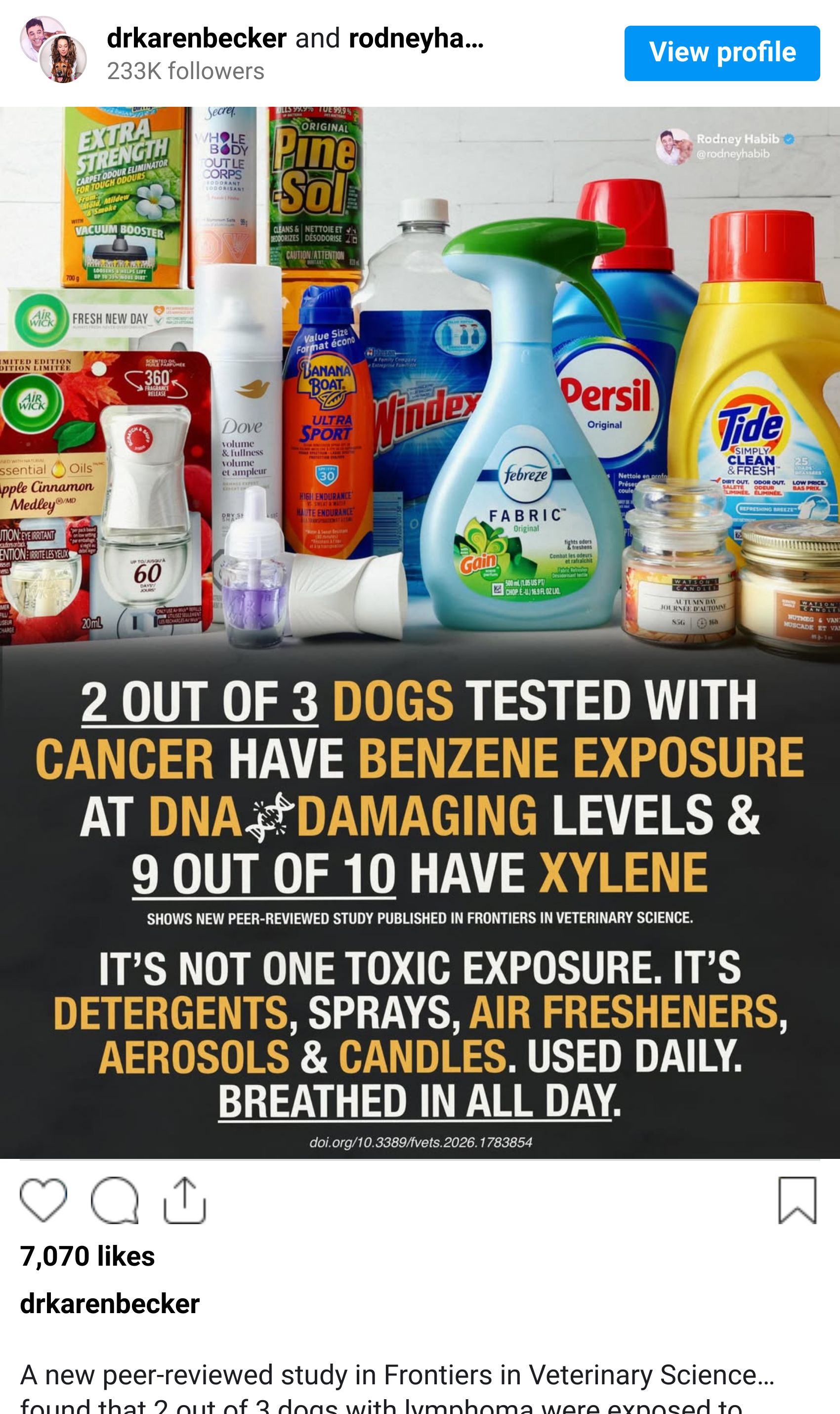
Read the caption a second time and it quietly takes itself apart.
Over half of the healthy dogs, it concedes, had similar benzene exposure, and nearly all of them carried xylene too.
So the sick dogs and the healthy dogs were lugging around roughly the same chemical load, which is not a finding about cancer.
It is a finding about houses, and it is being used to sell a detox powder.
We went and read the actual paper and the distance between what it says and what the caption implies is worth walking through.
This exact move, a real study bent into a reason to buy, now happens almost weekly in pet wellness, and seeing how the trick works is what surfaces the much larger opportunity sitting underneath it.
Same chemicals, sick or healthy
The study, published in April in Frontiers in Veterinary Science by a University of Wisconsin-Madison team, measured urinary VOC metabolites (the breakdown products a body leaves in urine after it processes volatile chemicals like benzene and xylene, which is how researchers confirm an animal was actually exposed) in 30 golden retrievers with multicentric lymphoma and 30 matched healthy controls, once at diagnosis and again a year earlier.
Every one of the 60 dogs had detectable benzene, xylene, and 1,3-butadiene in its system.
Exposure was universal.
Every dog, sick or healthy, was living in the same low-level background of household chemistry.
Here is the line the caption skips.
The sick dogs and the healthy dogs showed no meaningful difference in their chemical load.
When researchers compare two groups, they run a test that asks whether the gap between them could be nothing more than chance, and they report the answer as a number between 0 and 1.
The convention across science is that anything above 0.05 is too likely to be a fluke to take seriously.
The closest this study came to a real difference was xylene a year before diagnosis, which landed right at 0.05 and did not clear the line.
Benzene at the time of diagnosis came back at 0.91, meaning the gap between sick and healthy dogs was almost certainly random noise.
The authors went further and calculated that proving even the faint xylene signal, if it is real at all, would take more than 280 dogs in each group.
This study had 30.
It was never built to find the link the caption claims it found.

The "two out of three" and "nine out of ten" figures are real, but they measure something other than what the post implies.
They come from a modeling step where researchers estimate blood concentrations from the urine data, and the authors are explicit about how shaky that step is, writing that the values "should be considered exploratory estimates in dogs" because the math borrows from human and rat data that does not exist for dogs.
In one of those estimates, xylene, the healthy controls actually came out slightly higher than the sick dogs.
The lab-dish findings are real, to be fair.
Benzene and xylene did damage canine immune cells in a controlled experiment.
But damaging isolated cells at set doses is a long way from a living animal developing cancer, and the paper never bridges that gap.
The only thing the authors recommend doing about any of it is running an activated-carbon air filter rated for VOC removal.
No supplement appears anywhere in the study.
The honest summary is that exposure is real and nearly universal, the link to cancer is not established, and the science is genuinely unsettled.
That last part matters most, because the same lab published a study on boxers in the Journal of Veterinary Internal Medicine that pointed the other way, finding benzene levels roughly double in lymphoma dogs, who also tended to live in more urban areas.
Even that one was mixed.
It also measured two common weedkillers, 2,4-D and glyphosate, and neither separated the sick boxers from the healthy ones, though that is a narrow result about exposure levels in 40 dogs, not a verdict on whether those chemicals cause cancer.
Boxers and goldens also differ in the underlying biology of their lymphomas, which may be why one study found a signal and the other did not.
The takeaway for anyone marketing off this research is uncomfortable.
You can find a study to support nearly any headline you want, and brands reach for whichever one sells, while the full body of evidence still says we do not know yet.
The customer was already converted
Here is what we keep seeing, stated plainly as an observation rather than dressed up as data.
Every time one of these studies surfaces, interest spikes.
Engagement climbs, the comments fill with worried owners, and a brand is almost always ready with a product.
The spike is real even if no clean dataset will ever prove it to a statistician.
The more useful question is who actually buys when the spike hits, and the answer is rarely a new customer.
It is someone who already runs a low-tox home for themselves.
The air purifier is already humming, the water is already filtered, the labels already highly scrutinized.
They did not need convincing that invisible household chemistry matters, because they already believe it about themselves.
The study just hands them permission to extend a belief they already hold to a family member who happens to sleep on the floor (or in their bed).
That distinction carries more weight than it looks.
You are not converting a skeptic, which is slow and expensive.
You are giving an already-converted person a reason to spend again, and the pet reframes that spend past a hurdle most wellness marketing never clears.
Buying another gadget for yourself can feel indulgent, while buying protection for a dependent who cannot protect itself reads as responsibility.
Guilt is a steadier purchase driver than vanity, and the pet runs on guilt.
The spike is faddish and decays with the news cycle, but the underlying buyer is durable, anchored to a stable identity and a steady emotional pull.
A business built to ride the spikes is building on sand, because each study pulls demand forward and then the attention evaporates.
A business built to catch that spike traffic and turn it into a lasting relationship is building something else entirely.
The brands that recommend what the science actually supports, better ventilation and carbon filtration, tend to earn trust.
The ones translating the same papers into a daily detox narrative are renting attention they have to re-rent every news cycle.
The dog is the cheapest door into the house
Step back from the supplement and the opportunity gets larger.
The pet is a wedge, the lowest-friction way into the entire clean-home category, and almost nobody is treating it that way. The detox-supplement path is also the shakiest on its own merits, since the clinical evidence that any ingestible meaningfully clears these compounds from a dog is thin, which is its own reason to look past the pills/powders and at the rest of the house.
Consider how hard it is to sell clean-home to a general consumer.
You are asking someone to act on an abstract, deferred, invisible risk to themselves, and people are exceptionally good at ignoring abstract risks to themselves.
It is the same problem we wrote about with pet hydration, where the hardest thing to sell is a fix for something the owner cannot see.
The pet collapses that resistance on three fronts.
It creates urgency, because the animal is home all day, lives lower to the ground where heavier VOCs and settled dust concentrate, and grooms whatever lands on the floor, on a compressed lifespan that turns a twenty-year human worry into a five-year pet one.
It grants moral license, because protecting a dependent silences the voice calling the purchase indulgent.
And a sick or aging pet is concrete in a way that ambient home chemistry never is.
Once the wedge is in, look at the full stack it can open.
Air is the obvious first room and the one layer the science actually endorses, and it has a natural recurring revenue line because the carbon filters that capture VOCs need replacing every few months to a year.
Water comes next, and there is more room here than people think, since most owners do not know they are supposed to wash a dog's bowl daily, or that a slimy biofilm builds up in it within hours, which makes filtration and bowl hygiene an easier story to tell than it sounds.
Then surfaces, the cleaners and laundry, a classic consumable.
Then materials, the beds and toys and flooring, where a dog pressed against the same surface fourteen hours a day makes a low-tox claim genuinely pet-specific rather than borrowed.
And finally monitoring, the testing and scoring layer, which does not reduce anything itself but, done right, ties all the others together.
The catch is that most of these layers have no real pet-specific advantage.
An air purifier works the same whether it is cleaning the air for a person with asthma or for a labrador, and a water filter does not change because there is a dog in the house.
The pet framing is mostly a marketing layer on top, and that shapes who is positioned to win.
Why the product shelf is a trap
The obvious way into this market is to sell a product, a low-tox cleaner, a pet-branded air purifier, a cleaner-burning candle.
It is also the worst place to plant a flag, because the established clean-home and air-quality brands can move into it whenever they decide the pet buyer is worth the effort, and they are formidable.
The refillable cleaning brand Blueland has logged $300M in lifetime sales since 2019 on roughly $35M in funding, reached profitability in 2023, and grew revenue 80% in 2025 while expanding into Target.
Branch Basics has built a national footprint in non-toxic cleaning, and air-quality players like Coway, IQAir, and Rabbit Air already publish content aimed at pet households.
For any of them, a pet-marketed product is a small extension of what they already make and sell, which means a pet-first brand that competes there is fighting much bigger companies on their own ground, on margins that get worse as more of them show up.
The way out is to not compete on the product at all.
The product layers, the air and water and surfaces, are easy to enter and impossible to defend. The defensible position is the layer above them, the one that tells an owner what is actually wrong in their home and what to do about it, because that is the part the product companies cannot bolt on with a new SKU.
It is built from relationship and data, not hardware.

Nobody has built the score yet
This is the part we find most interesting, and the part the research kept circling back to. Picture a model that would actually be hard to copy.
An in-home environmental test, an ongoing score that tells an owner how the house is doing, continuous monitoring, and a subscription that resupplies what the results call for, the replacement air filters, the water cartridges, the swapped-out products.
A wearable for your house, basically, except the reason you care about the number is the animal living inside it.
The mechanics are already proven outside of pets, and the human version is moving faster than most people in pet realize.
On the product side, the Austin company Light Labs tests food, supplements, and baby food for heavy metals, pesticides, glyphosate, and microplastics, then turns the results into a transparency panel brands embed on their product pages.
And the closest thing yet to a wearable for your house, Lightwork Home Health, spends half a day inside a home measuring water, air, lighting, EMFs, and mold, scores all of it on a proprietary exposure index, and hands the owner a prioritized fix-it roadmap.
It is human-first, it is early, and it is already expanding city by city.
Notice what the most data-driven of these is already selling on.
Lightwork's own example findings flag a magnetic field in a child's nursery tied to childhood leukemia risk and baby monitors emitting radiofrequency.
The protect-the-vulnerable-member instinct is right there in the pitch, the same instinct that had Blueland's founder start the company while researching whether New York tap water was safe to mix into her infant son's formula.
The protected dependent is the reason these businesses exist.
What does not exist yet, as far as we can find, is any of this run through the pet lens.
No pet-first business at scale sells ongoing in-home testing plus a recurring health score plus subscription resupply, built around the animal.
The human version is here and gaining adoption, which makes the pet version look less like an if than a when, and the same network keeps surfacing in the human version.
Light Labs was founded by Nick Mares, whose brother Justin co-founded the clean-food brand Kettle & Fire, and Justin is an investor in Lightwork, a connection he walked through on My First Million last year.
The talent and capital that built a nine-figure clean-food company is now funding both the testing and the home-assessment layers, which is the kind of network that finds the next wedge early.
The trajectory points the same way.
Lightwork today is a premium in-person service, a few thousand dollars a visit, but the obvious next step is an AI-assisted version where an owner walks the house with a phone camera and the software flags the problems, dropping the price and widening the market.
Run that forward and the pet version almost designs itself, whether a company like Lightwork adds a pet and children module or someone builds a dedicated one from scratch.
As far as we can tell, that space is wide open.
A few things sit close enough to get mistaken for this and are worth ruling out.
Dog DNA tests advertise an "environmental risk score," but that reads the dog's genes, not the home.
Pet collars track the animal's body, not the house.
And mail-in kits that claim to test a dog's fur for toxins often rely on bioresonance, a fringe method with no scientific backing, so that corner is a caution, not a model.
The economics would look familiar to anyone who has run a consumables business.
Make the first test cheap or free to bring the customer in, then earn from the resupply the results justify, a retest every six to twelve months, and an inexpensive always-on monitor that produces the score and gives the owner a daily reason to open the app.
Retention depends on the score actually moving and the resupply being tied to it.
The asset that compounds, and the thing a product company cannot easily replicate, is the record of a specific home and animal tracked across years.
The score is only half a business.
You test someone's home, you hand them a number and a list of problems, and the very next thing they want to know is what to actually buy to fix it.
That answer is the other half of the model, and it is where the real money likely sits.
A service that already tests homes is perfectly placed to test products too, vetting the floor cleaners, detergents, candles, and beds an owner would otherwise have to evaluate blind, then pointing them toward the ones that pass.
Exposure-reduction products already exist and are looking for exactly this kind of distribution.
Companion Candles makes a low-tox candle built for homes with pets, the sort of product that belongs on a recommended shelf the moment a home's air score comes back poor.
Brands like that would pay to earn the mark and the placement, the same way they already pay for a Fear Free or NASC seal.
The test finds the problem, the approved-product shelf sells the fix, and the brands fund the verification.
A filter with a guilt surcharge
Here is the tension, and it does not resolve cleanly.
The most honest products in this category are the boring ones, a carbon air purifier in the few-hundred-dollar range, a water test, a low-tox bed.
They are science-aligned and real, and several are one-time purchases that do not naturally repeat, which is exactly why they are low-margin and unglamorous. The ones that convert hottest and carry the fattest margins are the soft ones, the detox supplement and the daily ingestible, many of which lean on fear and carry the most regulatory and scientific risk.
The service model bets that a subscription closes that gap, turning the honest, boring stuff into recurring revenue. That only works if the subscription delivers something an owner genuinely values, a score that moves and resupply that actually reduces what the dog is exposed to.
The hollow version looks identical from the outside, a commodity purifier with a dog on the box, billed monthly, attached to a score that never really changes.
The line between a service worth paying for and a recurring charge that is not is whether the testing leads to changes an owner can see and trust, and the human-side players are starting to prove people will pay for that.
Nobody has shown it through the pet, because nobody is doing it through the pet at all.
Whoever owns the test owns the relationship
There is a clock on all of this, and it is regulatory.
The FTC still governs "non-toxic" claims under Green Guides that date to 2012, the proposed revision has stalled, and several states have written those guides into their own law, so the exposure is live.
"Detox" and "removes toxins" claims fall under the agency's health-products substantiation standard.
And the FDA's Center for Veterinary Medicine has been warning pet companies whose wellness language crossed into unapproved-drug territory, with letters to three pet brands in April 2025 alone, putting the detox-ingestible path squarely in the enforcement lane.
Source reduction and monitoring is the lower-risk place to build, a quiet argument for the harder, more durable version of this business.
So here is where it nets out.
The wedge is real and cheap, because the pet pulls an already-converted household into a category they were primed to buy.
The product layers, the air and water and surfaces, are easy to enter and hard to defend, because the established clean-home brands can add a pet line whenever they decide it is worth it. The piece that is genuinely open, and genuinely hard to copy, is the testing, scoring, and trusted-recommendation layer, the part that turns a one-time worry into an ongoing relationship and a record of a home over time.
The studies are not going to stop.
The next one will land, the screenshots will circulate, and the supplements will be waiting.
A more interesting question is whether anyone in pet builds the thing that actually helps an owner answer what is in my house and what do I do about it, before the answer is just another pill.


