

🥹 Freshpet's new brand platform bets on emotional bond as the moat while fresh pet food gets crowded
💸 This fashionable & washable pee pad keeps selling out
👏 1,500 beagles have been rescued from a farm in Wisconsin
😃 Walmart just added a "clinical" dog food tier above its premium private label and it doesn't require a prescription
🙀 U.S. cat population grew 31% in a decade, nearly triple the rate of dogs
🏨 78% of pet parents would downgrade their own hotel to keep their pet with a 5-star sitter

About a month ago I was driving south on I-35 in Austin, TX when I caught a billboard on the right.
A tongue out pittie in pajamas on a couch. A red URL at the bottom: pittiematch.org.
Accompanied by a meme-proven copy line that read: "The perfect night in doesn't exis..." — just enough to keep my attention and make me think, damn there’s truly a matchmaking service for just about everybody nowadays.

My first read was of course a dating app.
Something Hinge-adjacent, maybe, or a Farmers Only for an alternative crowd.
I did not think rescue. I did not think shelter. I definitely did not think nonprofit. I did think, who the hell is behind this?
I looked it up at the next red light on Oltorf. What I found made a lot of sense to me, and I'll tell you why.
Pittie Match is part of a rescue campaign run by Love-A-Bull, an Austin-based pittie rescue, built entirely around the language and logic of dating apps.
The campaign is called Don't Let Misconceptions Create Missed Connections — and the URL was the Trojan horse.
I own a pittie. My co-founder Roy owns a pittie.

Left: Mapo (my dog) | Right: Shasta (Roy’s dog)
I am not a neutral observer when it comes to this conversation.
I've fostered dogs, I'm in multiple rescue group chats, and I've seen every version of the guilt-and-urgency ask you can imagine.
I know what it feels like to open the foster FB group on a Tuesday morning and see another "at capacity" post with dogs who’ve been there for several months.
It gets to you, and then eventually it just becomes noise unfortunately.
(This post is from a week ago, Texas shelters and rescues are almost always swelling past capacity…)
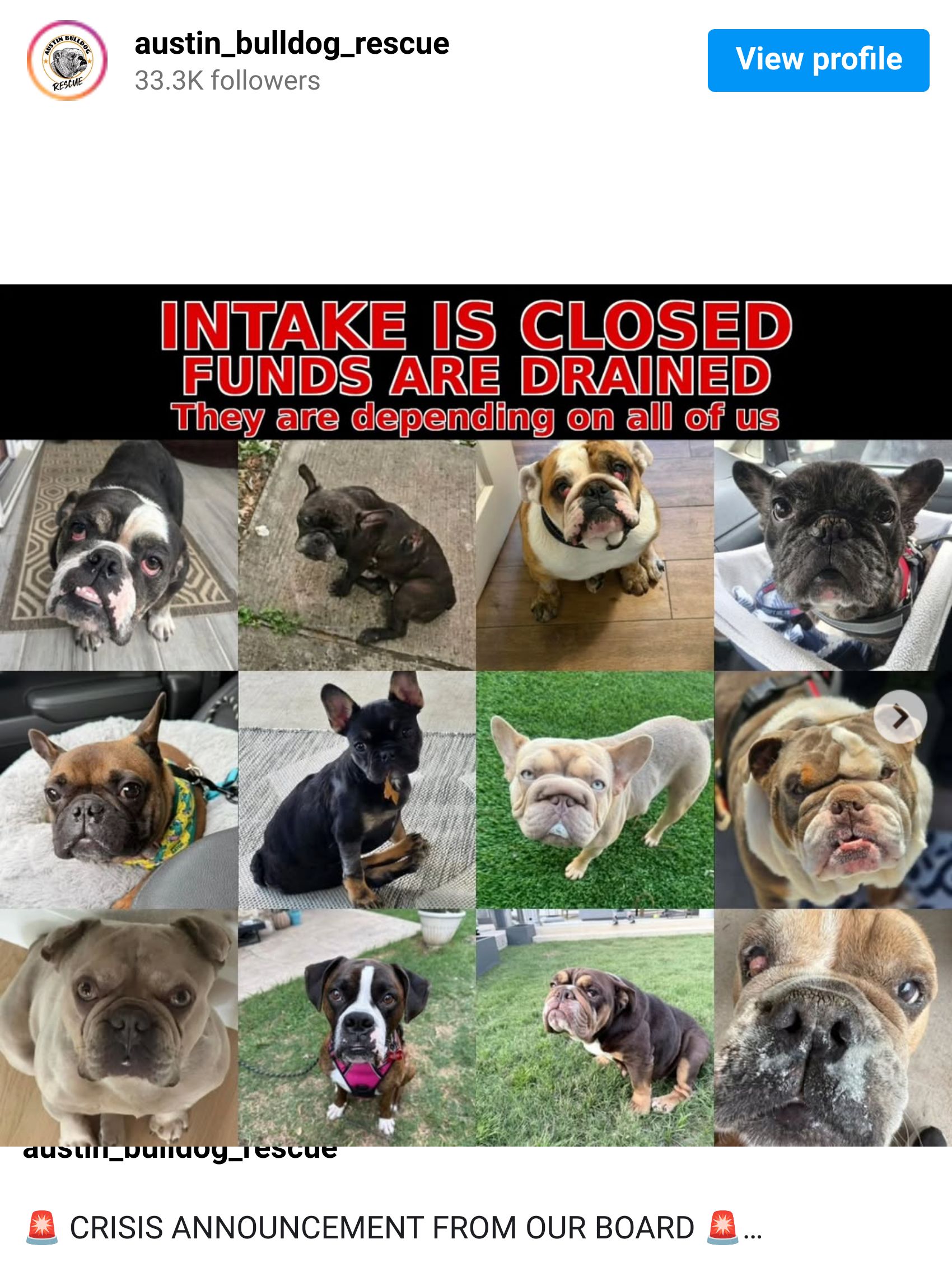
So when I say that this billboard made me curious instead of sad, that's not a small thing.
It was built by an all-volunteer rescue org with a nonprofit grant and a donated billboard slot.
The concept borrows from something most of us already know well. Finding a match through an app.
Except here, the match is a pittie.
The idea is that whether you end up fostering or adopting, it should feel like you found the right one for you, not like you responded to a plea.
Everyone Already Has the ASPCA Ad Memorized
The rescue marketing playbook has been running essentially unchanged for decades.
Sad eyes. Urgent statistics.
The weight of knowing an animal might not make it if you don't respond.
It worked, once, because guilt is a reliable short-term motivator and animal welfare campaigns learned early that the gut-punch drove donations and behavior.

The problem is what happens to that playbook over time.
Audiences build a specific reflex against stimuli they've seen too many times. It happens faster when the stimulus comes packaged in a recognizable genre.
The opening frame of a distressed animal triggers something that says, I know where this goes.
And once that pattern recognition fires, the message gets filtered before it even lands.
Not because people stopped caring about animals. Because the genre itself has become the skip signal. Not to mention it makes you feel god awful.
For pit bull-type dogs, the problem runs deeper than fatigue.
It's the label.
A study published in PLOS ONE by researchers at Arizona State University found that dogs labeled "pit bull" waited an average of 42 days to be adopted, against 12.8 days for visually similar dogs with different breed labels.
More than 3x longer.
When those same dogs were shown to potential adopters in photos without any breed label, they were rated equally attractive.
Hill's Pet Nutrition's 2024 State of Shelter Pet Adoption Report, surveying 2,500 current and prospective owners, found that fewer than one in four respondents said they were likely to adopt a large dog.
For small and medium dogs, that number was nearly double.
Large dogs with stigmatized breed labels aren't losing on anything intrinsic to the animal.
They're losing on a perception problem, and the marketing that leads with urgency and sad imagery is reinforcing the exact thing it's trying to fix.
I sat down with Macie Sharpe, who leads marketing for Love-A-Bull, an Austin-based pittie rescue that's been operating for nearly 20 years.
She's an accountant by trade who left a corporate role when her own dog got sick, took what was supposed to be six months off, and four years later is running the marketing function of an all-volunteer organization with no formal background in it.
Her philosophy on all of it comes down to one filter:
“If it’s not funny, then it’s not our brand.”
That's not a tagline.
It's an editorial standard she actually enforces.
And it explains why the campaign looks nothing like what rescue marketing is supposed to look like.
Guilt gets people in the door, she'll tell you. It doesn't make them stay.
The Coaster in the Bar Had No Photo of a Dog
Love-A-Bull built a landing page at Pittie Match to anchor it.
The concept flips the entire POV.
Instead of people looking for a dog, the dogs are looking for people.
Dating-app language, handwritten aesthetic, humor in every execution, and a URL that reads like a platform you'd sign up for on a Wednesday night.
The copy on the coasters and napkins distributed across Austin bars reads like Hinge prompts.
"I love my bed, but I'd rather be in yours."
"I'm not a player, I just fetch a lot."
"Looking for forever? I'm all in."
These are not cautious, shelter-friendly lines written by a committee. They're pickup lines written in the voice of a dog who knows what it wants.

None of the coasters or napkins contain a photo of a dog.
Just a handwritten-style line, a clever tagline, and a QR code.
Macie wanted someone at a bar to pick it up and not know what it was. To be confused enough to scan the code. She was engineering curiosity, not recognition.
The URL is pittiematch.org, not love-a-bull.org.
The campaign was built to serve the broader Austin and Houston shelter network, connecting people to dogs available through Love-A-Bull, Austin Animal Center, and Houston Animal Shelter.
If you arrive on the landing page cold, it quickly reads like a platform you join.

Every element was chosen to reach people who were not already inside animal spaces.
The people already in the rescue Facebook groups are already converted. The campaign was never for them.
The billboard came from a cold email to Lamar Advertising.
The person who answered happened to love pitties too.
They had unfilled inventory. Love-A-Bull covered the cost of printing the vinyl.
The same deal brought it back — when another slot opened up on I-35 with no advertiser to fill it, Lamar put the vinyl back up.
That's the only reason I saw it.
The Hansel Foundation, a grant partner supporting pittie-focused rescues, funded the broader campaign.
Total spend: $35,788, with $29,000 of that being the donated billboard value.
The photographer is an Austin-based commercial shooter who has worked with Post Malone on major brand campaigns and donated his time.
The result is photography that looks like a lifestyle brand shoot, not a rescue brochure.
Love-A-Bull has three internal brand pillars: the Hero, the Heartfelt, and the Joker. The Joker is the governing filter. If it's not funny, it's not their brand.
Most nonprofits have never written that down, let alone enforced it.
The campaign launched October, 2025. By April 2026, Love-A-Bull had distributed 15,827 coasters, napkins, and posters across 77 locations.
$9.50 a Click From People Who Came In Cold
The landing page logged 3,662 views and 2,218 unique users across the campaign window.
The billboard drove the most traffic at 2,801 calculated views, with coasters at 440, napkins at 229, and posters at 192.
At the top of the landing page, two calls to action.
"Find My Perfect Match" for people ready to meet a dog.
"I Wanna Sniff Around" for people wanting more context first.
510 chose the first. 330 chose the second.
The downstream number that matters: fostering link clicks came in at 1,868 and adoption link clicks at 1,887.
Nearly even.
The campaign produced 3,755 clicks to pages about actually getting a dog, from people who were not searching for one when the campaign found them.
It launched just before both Austin City Limits (ACL) weekends, and traffic jumped via QR code scans.
The attribution gap is real and Macie is direct about it.
She can tell you how many people clicked through to Austin Animal Center and Houston Animal Shelter.
She cannot tell you how many came back and actually adopted or fostered.
Shelter systems don't track referral sources at that level of precision.
What she can tell you is the cost math. Back out the donated billboard and the real cash outlay was around $6,788 against 3,755 intent clicks — under $2 each.
Include the donated billboard at full market value and it's roughly $9.50 per click from people with no prior interest signal.
Paid social for rescue causes frequently runs $15 to $50 per click against audiences already pre-selected for animal welfare interest.
My Misread Was the Mechanism
Here is what I understood when I looked up pittiematch.org at that red light just off the freeway - nothing about rescue, nothing about statistics, nothing about shelter capacity.
I'd seen something that didn't fit any category I was expecting, and I wanted to know what it was.
That is the mechanism.
The deeper move is not just that the campaign is funny, though it is.
It's that it doesn't look like what it is.
It borrows the visual language and tonal register of dating apps so fluently that the brain files it under something familiar and non-threatening before the message arrives.

Hinge billboard rooting for your success and their demise. Gives me a similar vibe to this campaign
By the time you realize it's about rescue dogs, you're already curious.
And that curiosity is the one thing guilt-based creative never earns, because it announces itself at the first frame and triggers the skip reflex immediately.
The fear-and-guilt playbook isn't unique to animal welfare.
Flea and tick products open with infestation.
Pet supplements hook with gut, paw, ear, itch, and grass eating anxiety.
Pet insurance leads from worst-case scenarios.
Dental chews run on periodontal disease statistics.
Any category where the default creative leads with what could go wrong has the same structural problem Love-A-Bull was solving.
When the conversation turned to fear-based marketing in pet supplements — Macie didn't hesitate.
She called the whole format outdated, said too many brands (especially on TikTok) had piled on and burned it out.
The market is starting to agree.
Fairbowl’s new pet food audit site is actively calling out brands that use fear based marketing and scoring them against it.

From Fairbowl’s grading system
It functions as a genre signal that tells people what to skip. She's right. And the brands still running it are not getting the results they think they are. Consumers are exhausted from being shamed or feeling lesser than.
I've been a pittie owner long enough to know that changing the narrative around this breed doesn't happen from one campaign, one billboard, or one newsletter story.
Roy and I both know what it's like to get the look from someone at the dog park who didn't expect to end up next to one. People ask me if I’m afraid that my dog will turn on my daughters at any moment.
The misperception is real and it's stubborn.
What Macie and her team built chips away at it in a way I haven't seen before, and she did it as a volunteer accountant with a cold email and a borrowed billboard slot.
Both Domains Are Owned. Nobody's Built the National Version Yet.
Love-A-Bull owns both pittiematch.org and pittiematch.com.
Blank versions of the campaign materials are available without QR codes or org branding so other shelters can download them, add their own URL and logo, and run a local version.
Five shelters have already reached out. Houston is already on the landing page.
The national version of this campaign has not been built.
The scaffolding for it already exists.
Distribution capital for localized materials in high-density pet markets across the country.
OOH partnerships in cities where inventory goes unfilled, which is replicable because the cold email worked once already.
A social layer built around post-adoption stories (everybody ❤ a love story).
And the discipline to fund it without covering the creative in your logo, because the campaign works precisely because it doesn't feel like a brand asking for something.
The model for how that works already exists elsewhere.
Tampa-based photographer Adam Goldberg has been running Second Shot — a program that provides professional adoption photography to shelters and rescues, funded entirely by brand sponsors.
Before Second Shot, Goldberg was photographing around 120 rescue pets a year.
With brand partnerships in place, he's now photographing over 1,000 annually.
He presented the model at Global Pet Expo this year under the framing of "glad-vertising" — brands funding creative that doesn't feel like an ad, in service of a cause that actually moves people.
Different execution than Pittie Match, same underlying logic.
A sponsor that respects that constraint gets something genuinely hard to manufacture: cause marketing that doesn't look like cause marketing.
Brand equity with an audience that sees through a press release from across a bar.
And a connection to a cultural moment in pit bull advocacy that is moving in a real direction, with 22 states now prohibiting breed-specific legislation and more following.
If you're a pet brand operator with ties to bully breeds, or a founder looking for a cause partnership that produces something real, the team is reachable at [email protected].
The campaign is still live at pittiematch.org.


