

🏃 Zoom Room bundles Fi trackers with training programs, adds in-gym leaderboards for 2026
🌎 FirstMate becomes fourth brand in Nasta's cross-border premium pet food rollup
😡 Pet influencer fakes dog kidnapping, claims he wanted to 'rediscover the joy of storytelling
➿ New AI pet wellness app uses specialized agents for lab interpretation, triage, and long-term tracking
🇮🇩 South Asia pet care projected to nearly triple to $23.5B by 2036 with Indonesia leading at 12.5% CAGR
🥶 Muhlengia's passive cooling pet bed hits -7°C without power, wins CIPS 2025 innovation award

On February 12, the Clean Label Project dropped a category study that tested 79 of the best-selling dog foods in America for heavy metals, acrylamide, and industrial contaminants.
Within hours, CNN ran the story.
Local TV stations across the country syndicated it. Instagram lit up with shareable graphics showing that dry dog food contains 13x more arsenic and 20x more lead than fresh and frozen alternatives.

That same day, Freshpet announced it had become the first and only pet food brand to earn Clean Label Project certification across its entire product line.
Also that same day, The Farmer's Dog published a detailed blog post explaining its own third-party testing practices and human-grade standards.
The Pet Food Institute, representing conventional manufacturers, issued a defensive statement challenging the study's methodology.
The major kibble companies themselves said nothing.

All of this happened in a single week.
And the speed tells the real story.
This wasn't a surprise for the brands that benefited from it. The ones caught flat-footed were the ones that dominate the category.
What the study actually found
Clean Label Project partnered with Ellipse Analytics, an ISO 17025-accredited lab, to run more than 11,000 individual contaminant tests across those 79 products.
The panels covered heavy metals (arsenic, cadmium, mercury, lead), acrylamide, phthalates (DEHP), bisphenols, glyphosate, and pesticides.
Products were split into three format groups:
50 dry foods
11 air-dried and freeze-dried
18 fresh and frozen
The headline numbers were stark.
Dry dog food averaged 184.6 parts per billion of arsenic versus 13.9 in fresh and frozen.
Lead averaged 180.1 ppb in dry versus 8.5 in fresh and frozen.
Acrylamide, a byproduct of high-heat processing classified by the EPA as likely carcinogenic, averaged 48.3 ppb in dry food with one sample hitting 780 ppb.
Fresh and frozen averaged 2.0.
Dr. Joseph Wakshlag, a veterinary nutritionist at Cornell who was not involved in the CLP study, told CNN the general findings tracked with his own 2018 research showing dogs consume three to seven times more heavy metals per calorie than humans.
That's the transparency tax, quantified by an independent scientist.
CLP benchmarked dog food results against more than 3,280 human food, beverage, and supplement products it has tested over the past decade.
The comparison exists because, as CLP points out, there are no comprehensive federal regulations specifically addressing dietary exposure to industrial and environmental chemicals in dog food.
The FDA's Center for Veterinary Medicine has not promulgated guidance, action levels, or tolerances for heavy metals in animal food.
Compare that to the granular action levels the FDA has proposed for lead in baby food and children's juices, and you start to see the structural gap CLP is attacking.
The Clean Sixteen tells the sharper story
The topline averages got the media coverage.
But the Clean Sixteen list is where the competitive implications get real.

CLP ranked all 79 products by cumulative contamination scores across six panels and published the 16 lowest-contaminant products.
Of the 50 dry foods tested, which included products from Purina, Blue Buffalo, Royal Canin, IAMS, Pedigree, Hill's, Wellness, Taste of the Wild, and dozens more, exactly two made the Clean Sixteen: Hill's Science Diet Small & Mini and Solid Gold Nutrient Boost.
That's a 4% inclusion rate for dry food.
Of the 18 fresh and frozen products tested, 14 made the list.
That's 78%.
The Clean Sixteen isn't a "fresh is better" marketing tagline. It's a ranked scorecard, and the results are lopsided enough to create a real problem for any brand selling dry food that was tested and didn't make the cut.
CLP doesn't publish individual product scores, so consumers can't see exactly how their specific brand performed.
But they can see the full list of products tested, they can see who made the top 16, and they can do the math on who didn't.
That ambiguity is actually the weapon.
It indicts the entire dry format by association, whether or not any individual product was particularly high or low.
And it hands fresh and frozen brands a story they can tell for years.
The coordinated offense
Freshpet didn't react to the CLP study. They were ready for it.
According to the company, certification of Freshpet recipes began in early 2025, meaning they spent roughly a year preparing for this moment.
Their entire U.S. and Canadian product line was tested for more than 100 contaminants.
The Purity Award, which CLP reserves for the top third of performers in a category, was announced the same morning the scary category data hit CNN.
This is a company doing nearly $1B in annual revenue with 13.5M household penetration.
They didn't stumble into a PR win. They built a certification machine and timed its deployment to coincide with maximum category disruption.
Seeking Alpha immediately published analysis suggesting the Purity Award could strengthen Freshpet's premium positioning. Transparency isn't just a marketing message here. It's becoming a valuation input.
The Farmer's Dog ran a different playbook.
They didn't pursue CLP certification.
Instead, their same-day blog post leaned on their own third-party testing program, human-grade production standards (AAFCO-defined), and a year-long feeding study conducted with Cornell.
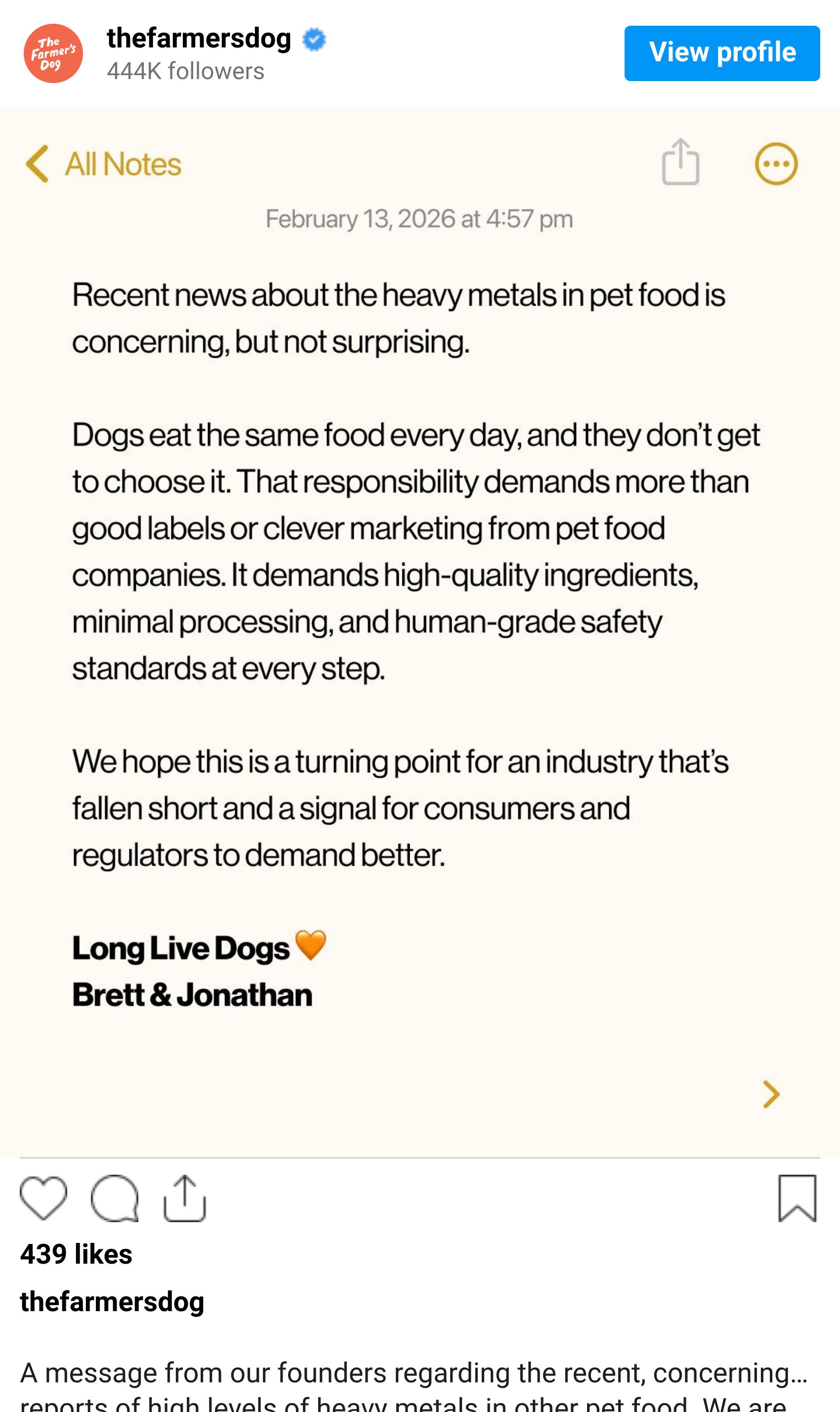
Their message was essentially: we already hold ourselves to this standard, and here's the data to prove it.
Where Freshpet chose platform certification (CLP's consumer mark), The Farmer's Dog chose brand certification (publish your own testing story, anchored by a university partnership).
Both playbooks worked because both companies had something to point to. That's the part that matters for everyone else.
The methodology debate is real, but it's also irrelevant
The Pet Food Institute's response raised legitimate scientific objections.
PFI argued CLP didn't account for moisture content differences between dry and fresh food, didn't compare findings against established safety thresholds, and didn't disclose sampling methods or product-level results.
The moisture point is the strongest critique.
Fresh food is 60-70% water by weight, so contaminants measured on a per-serving basis will naturally look lower.
CLP says it also analyzed results per kilocalorie and found the same pattern, but hasn't released that granular data publicly.
These are fair objections. And they are strategically beside the point.
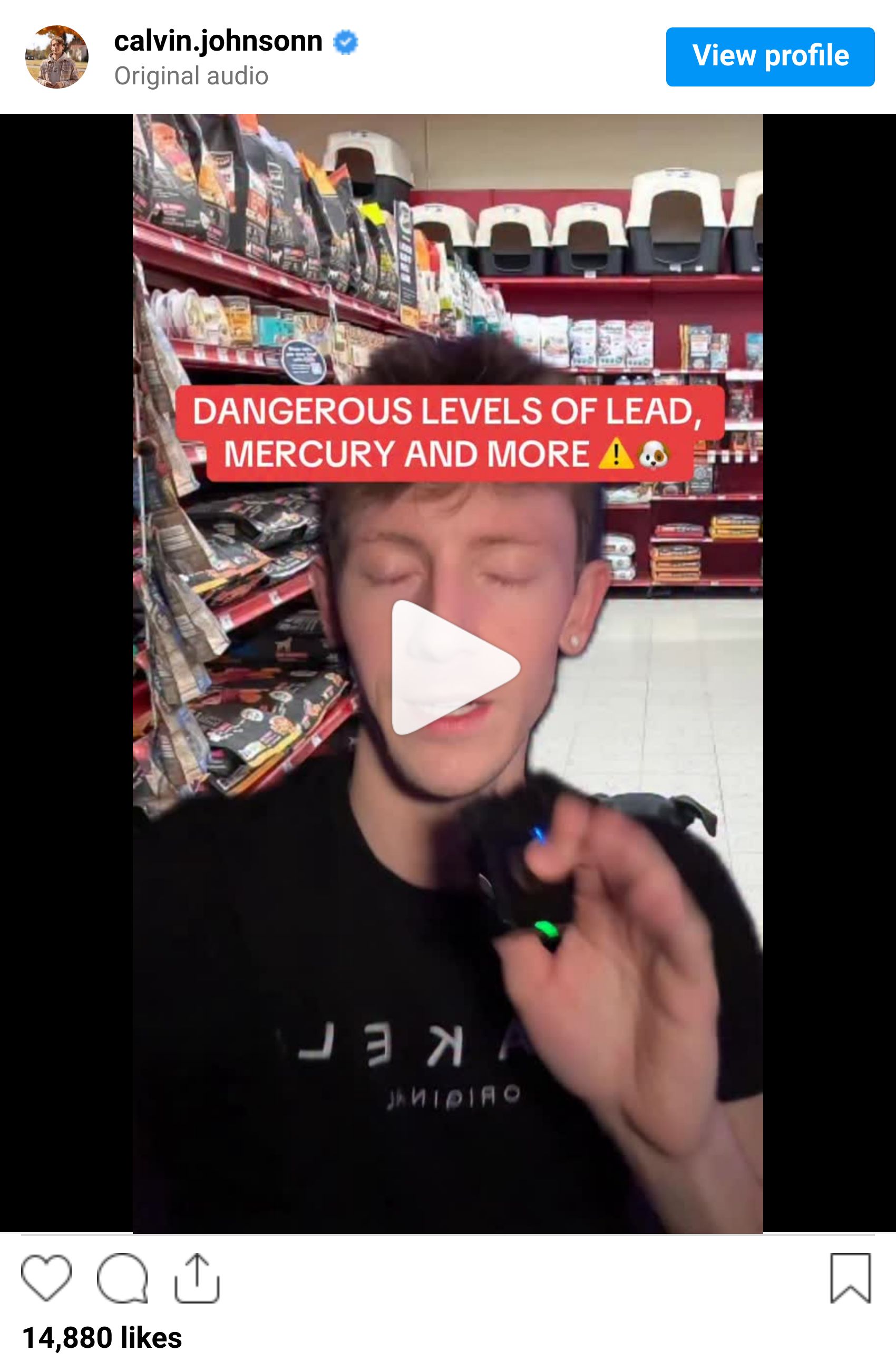
The study has already been processed by CNN, syndicated across dozens of local TV stations, repackaged into Instagram graphics, and absorbed by the exact consumer demographic that spends the most on premium pet food.
The narrative is set.
For operators, the question is no longer whether the methodology is perfect.
It's whether your brand has an answer when a customer walks in with a screenshot on their phone.
It's also worth understanding CLP's own incentive structure with clear eyes.
CLP is a nonprofit, but its certification program is a paid compliance system where testing costs are borne by the operator.
The category study creates demand for the certification product CLP sells in parallel. That doesn't mean the data is wrong, and CLP's use of an ISO-accredited lab provides a credibility floor.
But this is a business model, not purely an act of public service. Dog Food Advisor banned CLP references from their forum over transparency concerns.
Whole Dog Journal has published critical analysis of CLP's methodology and disclosure practices.

The format wars go scientific
The CLP study didn't arrive in a vacuum.
It landed in the middle of an escalating pattern where every pet food format is now under scientific scrutiny, and the studies keep arriving with funding or authorship ties to the formats they favor.

In October 2025, The Farmer's Dog published a year-long metabolomic study conducted with Cornell, showing that senior dogs fed fresh food experienced rapid and sustained metabolic improvements versus kibble.
The study was peer-reviewed and published in Metabolites. Wakshlag was a co-author.
But three of the study's authors were employed by The Farmer's Dog, and BSM Partners, a consulting firm that works with conventional pet food manufacturers, immediately challenged the methodology, calling the conclusions misleading.
The Farmer's Dog fired back publicly, saying if BSM believes extrusion doesn't matter, they should design and publish their own research.
Two days before the CLP study dropped, the UK's Food Standards Agency published a 380-product survey of raw pet food finding that 29% failed UK legal safety standards, one in five contained Salmonella, and 8% of packaging leaked during thawing.
That study, notably, came from a government food safety agency with no commercial interest in the outcome, making it arguably the most independent data point in the bunch.
So within four months, the industry produced ammunition against multiple formats.
Against kibble & Air-dried: heavy metals, acrylamide, and metabolic disadvantages.
Against raw: pathogens, antimicrobial resistance, and packaging safety failures. Against the studies favoring fresh: funding conflicts and methodological rebuttals.
The pattern matters more than any single study.
Science has become a competitive weapon in the format wars, and every piece of research now arrives pre-loaded with a business thesis.
Operators and retailers who want to navigate this honestly need to read the methodology sections and the conflict-of-interest disclosures, not just the press releases.
Kibble's three options
For the companies that collectively dominate the $40+ billion U.S. dog food market, the CLP study forces a strategic choice.
The first option is to pursue CLP certification or an equivalent third-party validation.
CLP's Clean Sixteen already includes two dry products, proving format isn't necessarily destiny.
But the certification process involves ongoing testing at the operator's expense, random sampling, and a contractual relationship with Clean Label Project Certification LLC.
For a brand with dozens of SKUs across multiple facilities, that's a meaningful cost commitment.
There's precedent for alternatives. Champion Petfoods published its own heavy metals white paper with third-party AOAC testing back in 2017.
SQF offers a pet food manufacturing code.
The American Feed Industry Association runs a Safe Feed/Safe Food certification.
None of these carry CLP's consumer-facing brand recognition, but they demonstrate that testing infrastructure exists outside CLP's ecosystem.
The second option is to invest in proprietary testing and publish results proactively, following something closer to The Farmer's Dog playbook.
This costs money (Wakshlag's $3-4 per bag estimate provides a rough benchmark) and requires brands to be confident in what the results will show.
The third option is to challenge the study, lean into PFI's moisture-content critique, and hope the news cycle moves on.
This is the weakest play. Instagram and TikTok content doesn't follow news cycles. It follows algorithms.
The "heavy metal levels in dog food" search results are now populated with this story, and they'll resurface every time a pet parent searches whether their food is safe.

"heavy metal levels in dog food" search on Instagram
The cycle may pass for general media. It won't pass for the discovery feeds where premium pet food customers actually live.
What none of the major kibble companies have done so far is say anything publicly.
Mars, Purina, Hill's, Blue Buffalo, Royal Canin: all had products in the study, none have issued public responses beyond PFI's trade-association statement.
It’s still very early, but that silence is a choice, and for now, it's ceding the narrative entirely to the brands that showed up prepared.
The real shift
The lasting impact of the CLP study won't be measured in parts per billion. It will be measured in how fast "tested and transparent" replaces "complete and balanced" as the baseline trust standard in pet food.
"Complete and balanced" has been the industry's credibility anchor for decades.
It means a product meets AAFCO nutritional profiles. It says nothing about contaminants, processing byproducts, or what an independent lab would find if it ran 11,000 tests.
After this study, that distinction is now visible to the consumer in a way it wasn't before.
The brands that understood this had a year to prepare. Freshpet built a certification machine.
The Farmer's Dog is building a science portfolio. Both deployed instantly when the moment arrived.
The question for everyone else in this industry is straightforward: if a third-party report drops tomorrow about your product category, what do you have ready to show?
The transparency tax is real.
And the brands that pay it early will set the terms for everyone who follows.


Heavy metals dog food" was a dead search term for five years. Then on February 12 it went vertical — 31,000 searches in a single month, a 4,000% year-over-year spike
