

💳 VANE just backed PawPay, which pays the clinic in full at checkout and takes on the insurance reimbursement itself
💊 CVS switched on pet prescriptions at roughly 9,000 pharmacies, aiming human-generic pricing at the vet clinic's highest-margin line
🇮🇹 Nestlé Purina is sinking $644M into an Italian wet-food plant, betting Europe's premium shift lands on wet, not fresh
📈 Virbac grew companion animal 10% in a half that flattened Boehringer, same market, opposite results
🧬 Andrew Huberman keeps calling pet peptides the next wave, noting dog owners are already dosing BPC
🐶 Puppy Sphere is taking its first outside capital after bootstrapping a puppy-wellness chain to 13 studios and $14M+ revenue
🐱 Rapper Xzibit went viral explaining how his cat lived to 20

On the first of every month, the maker behind Nostalgic Nooks in Brooklyn posts a new batch of pet beds built out of gutted 1950s televisions and radios, and within a day or two they are gone. The inventory page is almost always sold out. Custom orders are booked out to March 2027. He also runs an Amazon storefront that does not sell the beds at all, only the tools and materials he uses to make them, so the people who cannot buy one can go build their own.
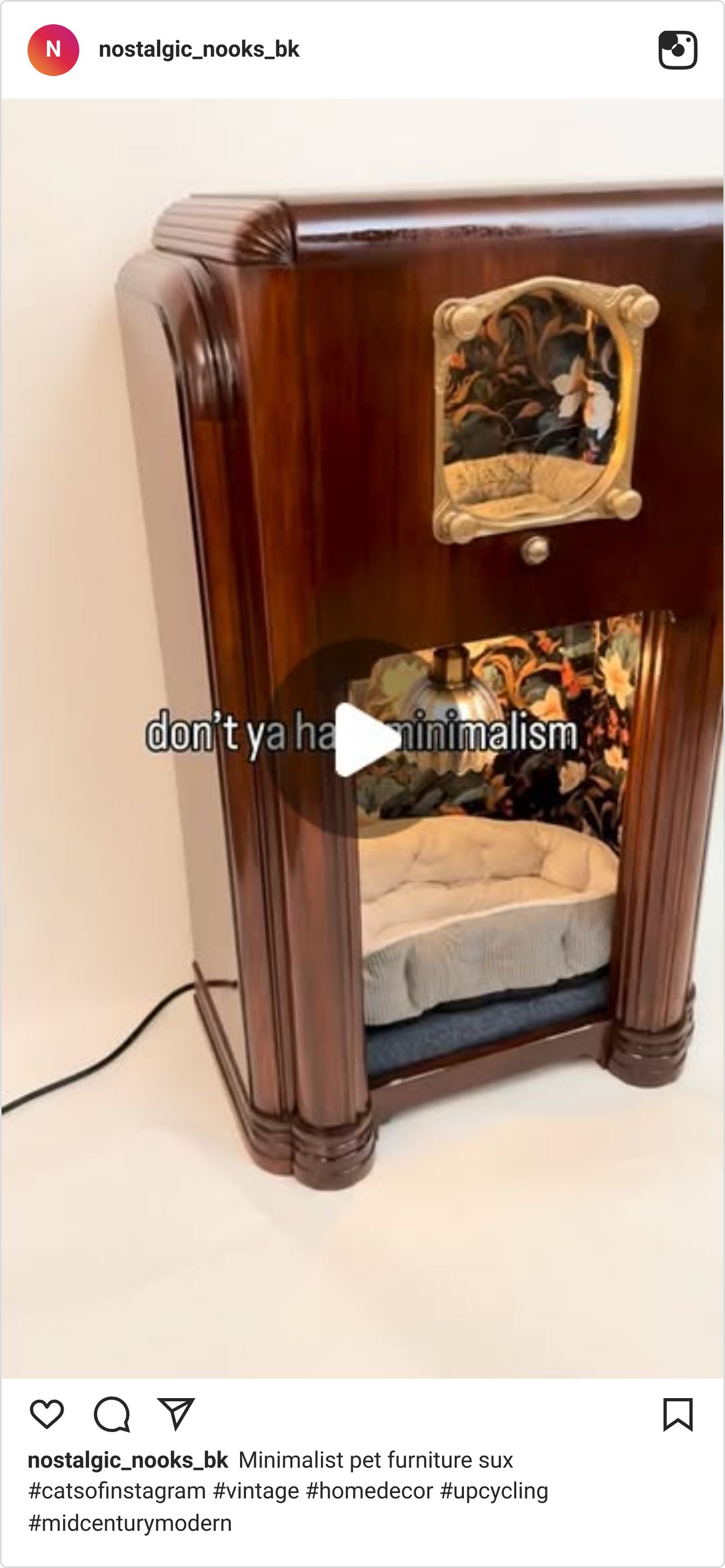
The account has more than 200,000 followers across Instagram and TikTok and a feed full of six-figure-view videos. The beds are beautiful, the waitlist runs almost two years, and the whole thing runs on one man’s hands.
He is not the market, but he is a sign of it. The appetite for cat furniture that looks like furniture has outrun the people making it, and the pet industry is mostly not the one meeting it.
We have been circling this one for a while. Walking Global Pet Expo this year, we kept noticing how much of the floor was built for dogs, and how thin the genuinely cat-first brands were by comparison. It stuck with us as a question worth answering, what the real cat-specific challenges and openings actually are, and then a video gave us the excuse to dig back in.
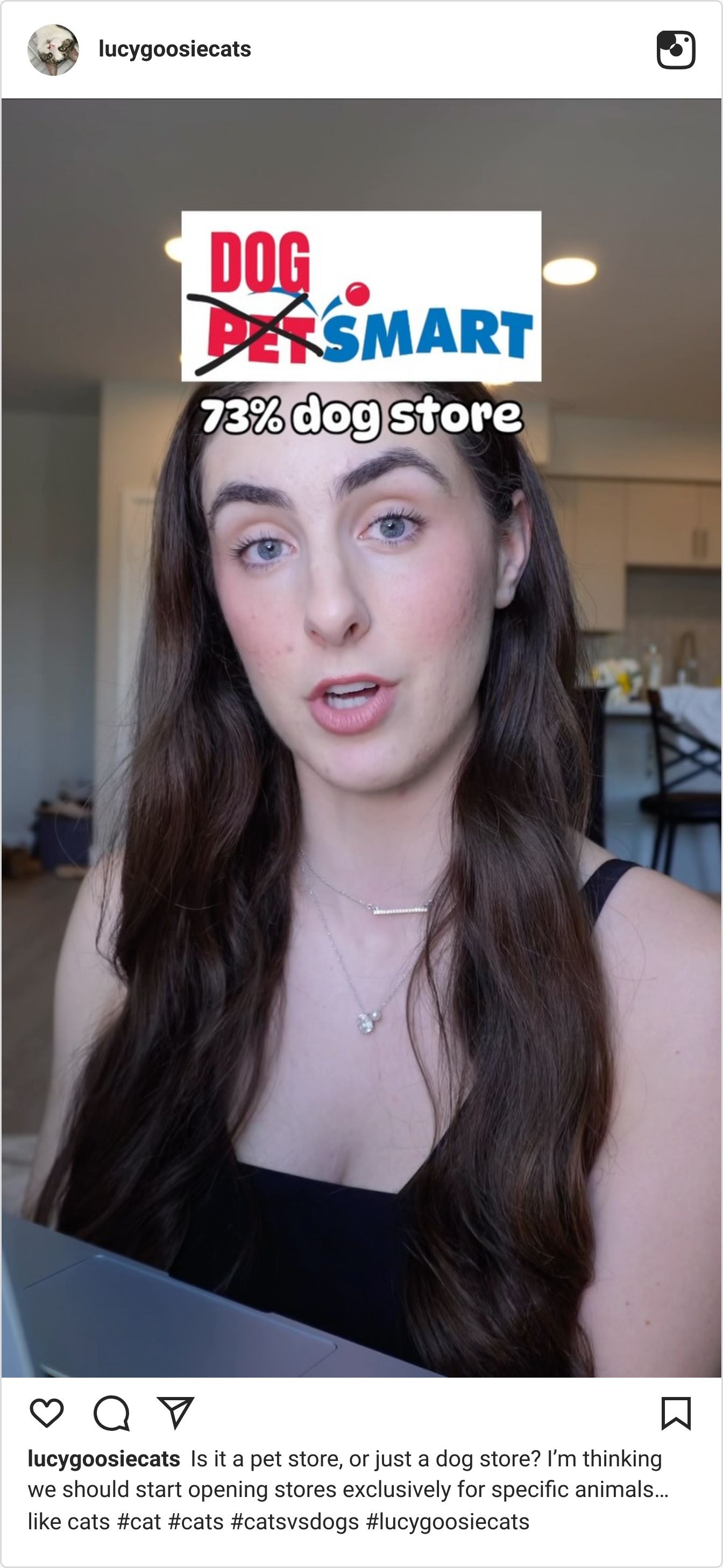
A creator who posts as Lucy Cu Cats tallied the toy selection on the biggest pet-retail sites, found it built overwhelmingly for dogs, and announced she was opening a cats-only store. Her count was good, and we wanted to know if the pattern held everywhere. So we ran our own, pulling live product counts across Petco, PetSmart, Chewy, and Wayfair, cat-versus-dog search demand, and cumulative cat and dog engagement on TikTok. The picture that came back is consistent. Cats are fed as well as dogs and get almost nothing else, the categories with the thinnest shelves are the ones cat owners chase hardest, and the brand that speaks to all of it has not been built.
Cats eat well. That is where the parity ends.
Start with the shelf, because assortment is the most honest statement of what a retailer believes its customers will buy.
On Petco the day we counted, cat food and dog food were effectively tied, 2,360 cat food listings against 2,328 for dogs. Where the purchase is nutrition, the cat is served, and always will be. Cat food and treats are already a roughly $22B business in the US, and every format that breaks in dog, fresh, gently cooked, freeze-dried, follows fast to cat. With a pool that size moving that quickly, nobody leaves the bowl half-stocked.
Then the parity ends. Cat treats ran 522 against 1,456 for dogs. Cat health and wellness, 308 against 1,031. Cat beds, 256 against 629. Cat collars, leashes, and harnesses, 192 against 1,201. Cat apparel, 50 listings against 959 for dogs. On the same site where cat food matches dog food item for item, cat clothing is stocked at about one twentieth the depth.
Roll the buckets up and the split is clean. Nutrition, food and treats together, runs about 43% cat. Everything else, the gear and the durables and the accessories, runs in the low twenties. Chewy shows the same shape when you measure it by catalog depth, cat food close to half of dog food, cat toys about a quarter. Two retailers, built years apart, arrived at the same architecture.

We are not reading that as neglect. There are real reasons a dog aisle runs deeper, and we will give them a fair hearing in a minute. The point for now is narrower and factual. Pet specialty treats the cat as a mouth to feed and treats the dog as a life to outfit.
The gear economy went to the furniture store
If cat owners are not buying gear at the pet store, the obvious question is whether they are buying it at all. They are. They are just buying it somewhere the pet industry does not closely track.
We ran the same count on Wayfair. Cat trees, perches, and scratchers returned 10,729 listings. Petco carried 590 in the comparable category. The furniture retailer lists on the order of 18x the cat furniture that the pet-specialty leader does. Wayfair's cat cages and catios category, at 4,540 listings, is larger than its dog crates or its dog houses.

That number is easy to overstate, so let me be precise about it. Wayfair sells furniture and decor. It carries no cat food, no litter, no consumables, so this is not a claim that Wayfair owns the cat category. The cat durables and enrichment demand, the trees and the perches and the enclosures, is being met well outside the pet channel, in the home-goods aisle where a cat tree is shelved next to bookcases, side tables, and lamps.
Two honest caveats. First, marketplace counts are inflated. A large share of those 10,729 listings are near-identical towers from the same handful of factories, relisted by dozens of sellers under different names, the same undifferentiated inventory that floods Amazon, so the number is an order-of-magnitude signal about where demand is served, not a claim of eighteen times the genuine selection.
Second, the pattern is not uniform. Wayfair cat beds run only about 13% of dog beds, the reverse of everything else. That reversal is a clue, not a contradiction. Cats do not use a cushion on the floor the way dogs do. Cat durables demand routes into cat-native formats, the vertical tree, the perch, the scratcher, the enclosed box, not the shrunken-dog-bed format. Serving cats is a different product architecture, not a smaller version of the same one.
The dog aisle runs deeper for reasons that are not all bias
Here is the counterweight, because the easy version of this story blames retail buyers and the honest version does not.
A dog is integrated into public life in ways a cat usually is not. Federal land requires dogs to be leashed in a way it never asks of cats. Service-animal law is written around dogs. Per APPA, a majority of dog owners take their dog out on foot for errands, and a large share travel with the dog by car and by plane (haven’t seen any cat dedicated airline names as of late). That public life mechanically generates categories, harnesses and travel carriers and weather gear and apparel, that a mostly-indoor cat simply does not need. Some of the gear gap is not neglect. It is biology and routine.
The consumables gap runs the other way, toward the incumbents. On Amazon, cat supplies are already a multi-billion-dollar business, reported at roughly $4.8B in 2023 and growing, and the top sellers are the legacy giants. Fresh reads put Amazon's whole pet category around $22.6B, with cats somewhere between a quarter and a third of it and growing at least as fast as dogs, though the exact share moves depending on who is counting and what they count. A newcomer is not going to out-Amazon Amazon on a case of Fancy Feast delivered tomorrow at the lowest price. That fight is real, and it is not the opening.
So the steelman holds on two fronts. Part of the gear gap is rational, and the commodity-consumables lane is spoken for. Keep both in mind, because the opportunity has to survive them.
The demand is loudest where the shelf is quietest
Now the part that is harder to explain away. In the specific categories where the shelf is thinnest, the demand signal is not just present. It is louder for cats than for dogs.
Take the harness, the emblem of the indoor cat venturing out. In the search data we pulled, cat harness draws about 33,100 US searches a month, cat backpack another 35,000, cat harness and leash close to 10,000, roughly 76,000 monthly searches for walking a cat, against the 192 cat harness and collar listings Petco stocks.
Social points the same way, and here we grade our own number. Dog harness content runs 83,474 posts to cat harness content's 19,292, more than 4x the volume, while each cat harness post earns more views, roughly 9,100 to 6,400. Views per post is skewed by the occasional viral hit, so read it as directional. It matters because it agrees with everything else, not because it stands alone.
@nocas.world Noca’s most chaotic moments so far on our 3 month van trip! I hope this made you smile like she makes us smile everyday🩵 #adventurecat #tr... See more
The cleaner comparison is strollers. Cat stroller content has fewer posts than dog stroller content, roughly 11,000 to 15,000, and more total views anyway, 111M to 74M. Fewer pieces of content, more attention, no denominator to argue about. Adventure-cat content has accumulated close to 2B views to date, and catio content nearly 900M views across 44,000 posts, alongside about 90,000 monthly searches where catio ideas and diy catio run five to one ahead of catio kit. People search for how to build the thing far more than for a finished one to buy, because a finished one to buy is mostly not there or customizable enough.

One number reframes all of it. On TikTok, the tag catsoftiktok has accumulated on the order of 747B views. Cats are not a quiet corner of the internet. They are a substantial share of the reason the internet is entertaining, and the audience a cat brand would need to reach is already there, already engaged.
The identity is the part nobody has claimed
There is one corner of the culture where dogs still lead. It is not the whole story, just a clear example of how the cat-and-dog split plays out.
The identity tag dogmom has accumulated tens of billions of views and, more to the point, a decade of brands, apparel lines, and marketing built on top of it. It is a fully commercialized identity. Freshpet even hired Meghan Trainor to write a song called I'm a Dog Mom for it.
The cat equivalent, catlady, sits far below it, and the reason is not a shortage of cats. Cat lady has been a punchline for generations, and it has never been claimed and built into a community at the scale dog mom has.
The tag catdad has drawn several billion views and is closing on dogdad, nearly at parity, and that tracks with who is actually driving cat ownership now. US cat-owning households jumped about 23% in a single year, roughly 9M homes, the fastest gain on record, and men are leading it. Around 38% of Gen Z cat owners and 46% of Millennial cat owners are men, with young male cat ownership up sharply since 2023, per the CATalyst Council's 2026 State of the Cat, which also finds Millennials are now the largest cat-owning group. The stereotype was a lonely woman. The growth is a young guy posting his cat.
None of this is any one company's to seize. An owner identity gets built by the culture first, the way dog mom did, and then by whoever is smart enough to give it a home. For cats, that home does not exist yet, and it is the one of the most interesting things on this list to watch.

Capital already sees it
The money has started to move, which is usually the last confirmation that a gap is real.
General Mills paid $1.45B for Whitebridge's premium cat feeding business, Tiki Pets and Cloud Star, in late 2024. Whisker, the maker of the Litter-Robot, was explored for a stake sale near a $1B valuation. Mars bought the litter brand PrettyLitter. Zoetis bought the cat-genetics startup Basepaws. In the UK, the fresh cat food brand KatKin raised $50M in late 2025.
The Mars-backed Companion Fund sits on the cap table of both Smalls, the cat food brand, and Tuft & Paw, the cat brand that started in furniture. The same strategic money is already inside cat consumables and cat durables. Capital has found the category. What it has not backed yet is the brand that assembles the whole thing and owns the culture around it.
A few brands get it, one product at a time
The gap is not that nobody makes a beautiful cat product. A handful already do, and they are good. Mau sells sculptural wooden cat trees that read more like boutique furniture than a pet-aisle SKU, designed with cat behaviorists and priced from a couple hundred dollars into the high hundreds, and it is stocked well beyond its own site, at Anthropologie, Chewy, Wayfair, Petco, even the registry site Zola. The appetite is real enough that people search for a mau cat tree dupe, hunting the same look at Hobby Lobby prices. Smaller labels work the same territory from other angles, Knead with a design-first cat bed, Cattasaurus with a plush cat cave. Cats are one of the few corners of pet where novelty and design actually sell, where a tree or a cave doubles as decor in a way a dog crate never does.
One brand is pushing past a single category. Tuft & Paw started in furniture, moved into a litter that now outsells it, added food, and is building connected devices, and its founder describes the plan without hedging. "There's a lot of pet brands, a lot of dog brands, but we want to do everything for cat people," Jackson Cunningham told us on our podcast. Mars' venture arm led its most recent round. Someone is clearly trying to build the cat brand.
But even Tuft & Paw is a vertical brand making its own products, not a destination that curates the best of everyone else's, and none of these has turned its audience into the owner identity dog mom already carries. The products are getting made. The place that pulls them together, with a point of view a marketplace cannot fake, is not here yet.
What the unbuilt brand would have to be
So what is actually missing. Not food, that is the part of the cat category already served well and fought over. Not another undifferentiated cat tower, Wayfair has ten thousand. What is missing is a cat-native retailer and identity in one, a curated storefront with a point of view, carrying the good version of every category the big boxes understock, the modern furniture and the real catio and the adventure gear and the fountain, wrapped in a brand that speaks cat culture at a depth a general merchandiser structurally cannot.
The pieces argue for that shape specifically. The durables demand is proven and served badly. The consumables belong in the mix, not as a battleground with Amazon but as the repeat-purchase engine that earns retention and funds the rest, weighted toward the emerging and premium brands the marketplaces bury. The culture is enormous and already engaged. And the owner identity is still up for grabs.
There is one fight this brand cannot win and should not pick. It will never beat Amazon, Chewy, or the big boxes on convenience, delivery speed, or price on a commodity case of food. Those are lost fights. What is winnable is everything those players are structurally bad at. Curation in a category drowning in identical listings. A product point of view. Trust. And a cultural fluency that a marketplace algorithm cannot fake.
Where we would look
The honest uncertainty is worth stating plainly, because we cannot see one thing from the outside. We do not have sell-through. We can prove the demand is loud and the shelf is thin, but we cannot prove from here that a wider cat assortment would turn as well as a dog one does. It is possible that pet specialty has quietly run the math and concluded that cat durables are a home-goods purchase that was never theirs to win. That is the real question under all of this, and it is the one a would-be founder should pressure-test first.
But the signals a founder would want are already lit. Ownership is growing and skewing young. Cats hold price in a way dogs do not, with wet cat food producer prices up more than 6% since May 2024 against under 2% for dogs. The durables demand is visibly leaking to a furniture site with no cat point of view. The culture is measured in hundreds of billions of views. And the strategic capital is already circling the edges of the category without anyone having built the middle.


