
💰 Vetspire spun out of Thrive with Battery Ventures backing, testing whether AI vet software can raise without a strategic parent
🐈 A feline muscle-loss drug beat placebo in the first randomized trial of its kind, on a very small sample
🥩 JustFoodForDogs took its vet diets to seven prescription SKUs, right as Royal Canin enters fresh therapeutic food
📱 Whisker opened a TikTok Shop after its impressions grew 300x in a year, a category leader betting on a platform built for challengers
🚀 Pawsible Ventures opened Cohort 2 applications for its pet-health incubator, after eight companies made the first cohort
✈️ JSX made big dogs bookable online, still capped at 80 lbs and still riding at the price of a full seat
🗣️ A review-panel participant says Purina ONE has a fresh line coming, unconfirmed by Purina and the biggest legacy entry yet if it holds
🐶 Bad Bunny's beagle Sansa covers Vogue's Dogue issue, now an annual franchise of its own

On Long Island, a dog owner can walk into a store, watch that day's recipes come off the line, and buy fresh food by the pound for as little as $4.83. Buy from The Farmer's Dog, Ollie, or Nom Nom instead, and that same owner fills out a quiz, waits on a box, and pays more.
Fresh dog food already won its argument, and the money says so. The Farmer's Dog crossed roughly $1.2B in annualized revenue and turned profitable. Ollie sold to Spain's Agrolimen for more than $600M in February. Mars bought Nom Nom, reportedly for around $1B. Spot & Tango is past $100M in annual recurring revenue and put $3.5M behind its first TV and out-of-home campaign.
That capital all bought the same shape of business. A sleek website built to push you into a quiz and a trial box, tuned and re-tuned because that funnel is the spine of acquisition, then a dry-ice shipment to the door. What none of it bought was a place a dog owner can walk into.
Natural Hounds is a Long Island company franchising that missing place, a storefront that cooks food on site and hands it across the counter. Its bet is that the category's next winner is a storefront rooted in the neighborhood it feeds, not a brand a customer only ever meets through a screen and a delivery box.
Fresh is proven and the storefront is still open
US pet spend hit $158B in 2025 and is projected at $165B this year, with food and treats the largest slice at $69.7B. Freshpet passed $1.1B in 2025, up 13%, though its growth is decelerating, down to 8.6% in the fourth quarter and guided to 7-10% for 2026. That slowdown is a sign of a mature category, not a fad cooling off.
What is newer is who else is showing up. The legacy players watched DTC newcomers take share and decided they had to sell fresh too, outside the kibble bag. Blue Buffalo launched a fresh line targeting a stated $3B category. Hill's bought into fresh by acquiring Prime100, then rolled out its own refrigerated Science Diet line. JustFoodForDogs is in more than 900 PetSmart stores.
Every one of those moves is a packaged product on a shelf or in a freezer case, not food made where it's sold. The DTC brands testing physical retail are doing it through somebody else's store. Native Pet went into Tractor Supply. Ollie went into Petco. Every scaled fresh brand runs the same sequence, a website out front and a doorstep at the end. Natural Hounds runs it backward, cooking on site and selling from a counter first.
The subscription box has costs a storefront doesn't
Every DTC brand in this category bakes frozen freight into its price before the food is made, while 77% of Natural Hounds' orders are picked up in store and never enter a shipping network at all. The DTC playbook works, and it has two costs that compound as it scales. Acquisition keeps getting more expensive, and the relationship it produces is transactional by design.
ButcherBox's CEO put a number on what other DTC operators describe. Acquisition costs across Meta, YouTube, and podcast ads rose 25% to 40% depending on the channel. That is the cost of buying attention before a brand has sold anything, and it climbs as the platform gets more crowded. Pet DTC brands have run efficient funnels compared to other verticals, but efficient doesn't mean cheap, and it doesn't mean getting cheaper. This isn't Meta being uniquely brutal for pet food. Every dollar there buys a stranger's click, and the auction climbs as more brands bid into it, from funded newcomers like Golden Child, fresh off a $37M fresh launch, to giants like Blue Buffalo, backed by General Mills, that can outspend almost anyone on the same channels.
Spot & Tango is already reacting to that pressure. The company built its growth almost entirely on lower-funnel, direct-response digital marketing, and at past $100M in annual recurring revenue, it moved real money into TV and out-of-home for the first time, $3.5M and counting, a step performance-first DTC brands typically take once digital channels stop scaling as cheaply as they used to.
The second cost never shows up in a CAC spreadsheet. A subscription scales by taking the human out of the loop, which works right up until a customer needs one. In the competitive review data we've pulled on these DTC brands, the harshest complaints skew less toward the food than toward service and cancellation, the kind of moment Roy wrote about publicly after canceling Ollie when his dog passed. Those complaints cost more than the customer who left, they also warn off the next shopper weighing whether the potential exit is worth the hassle.
A counter answers that.
A person behind it knows the dog, slips it a house-made single-ingredient treat, and clocks when the dog goes off its food or an owner's budget gets tight, the kind of moment that turns a silent cancellation into a conversation.
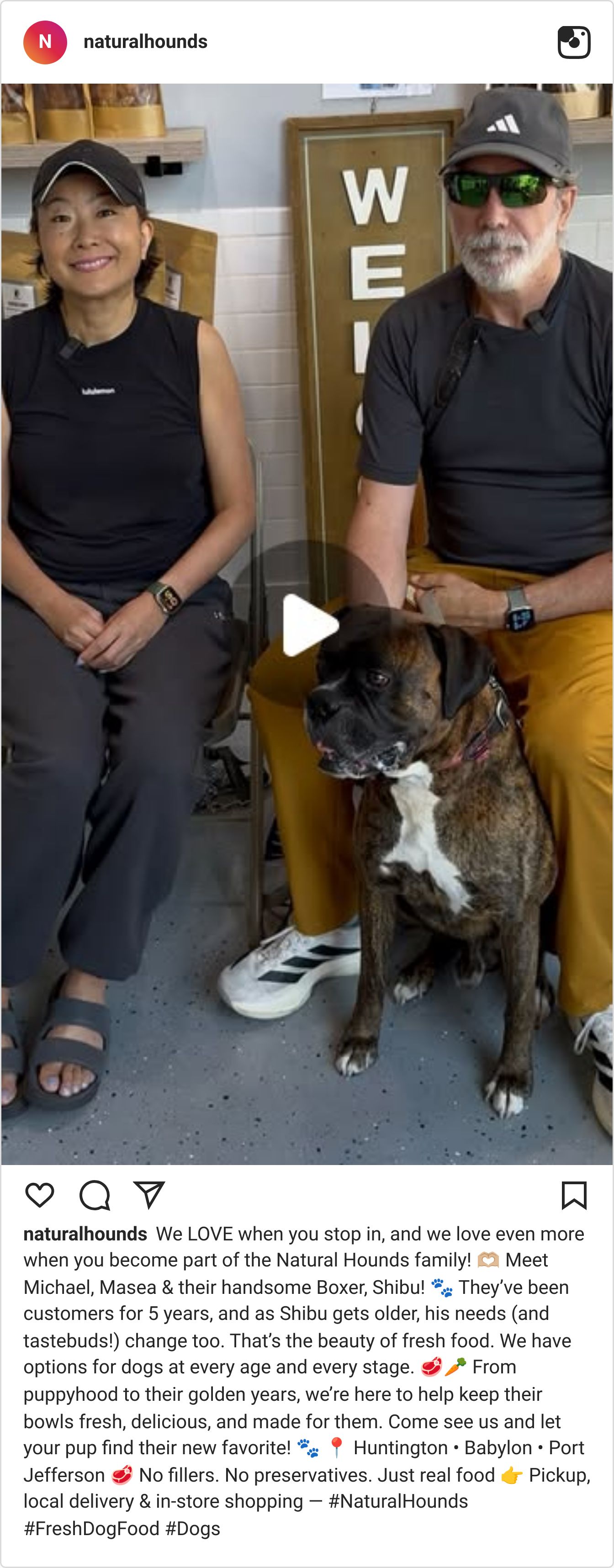
What a community kitchen sells
Natural Hounds runs what it calls a community kitchen, a single space that's retail counter and production facility at once. Each location produces roughly 600 to 800 pounds of food a day across four cooked recipes, beef, turkey, pork, and lamb, frozen overnight and available warm off the line most afternoons.

The company has sold an estimated 800,000 to 900,000 pounds of food over the past four years. The recipes are AAFCO-certified for all life stages, developed in-house rather than through a branded vet partnership, with a meat content the founders say runs higher than most of the category.
Roughly 13% of food customers also buy the company's single-ingredient treats, an early cross-sell for a store that sells more than one thing under one roof. Natural Hounds added a raw line that launched on August 1st, priced at the same rate as its cooked food, no premium for going raw. Most raw brands charge a markup over cooked, because raw is harder to produce and ship safely. A kitchen that runs its own cold chain can absorb that cost instead of passing it on.
The mix looks nothing like a DTC subscriber base. 85% of orders are one-time, and 77% happen in-store rather than by delivery. That opens up a buyer the subscription model struggles to reach, the occasional fresh feeder who won't commit a dog to an all-fresh diet but will use it as a topper or an every-so-often treat, and buys a pound whenever the mood strikes. Natural Hounds still sells a membership to regulars who want its best everyday pricing, it just doesn't need anyone locked in to make the model work.
The price advantage is local
Fresh dog food has always had an affordability ceiling. Natural Hounds' answer is doing the cooking locally and pricing it like groceries, not a subscription box. Its Original recipe runs $4.83/lb at the 30lb bulk tier.
The fresh-cooked DTC brands are harder to price-check, because none of them publish a flat per-pound number, all three gate pricing behind a personalized quiz built around a dog's weight and activity level. For a 45lb, highly active dog eating roughly 1.35lb a day, the closest available estimates put every one of them above Natural Hounds:

Prices were checked on August 14th, 2026, and the DTC figures are our estimates rather than rates those brands publish, so read them as directional. The pricing experience is different too. DTC brands put the number behind a quiz; Natural Hounds shows what each box costs before you buy.
That price is a pickup price, and it’s worth seeing what happens when the food has to travel. Natural Hounds charges $15 for local delivery, which works out to about $0.50/lb on a 30lb box and lands a delivered order near $5.33/lb, still the cheapest number in the table. Ship the same box outside the delivery area and the store’s own checkout quotes $39.36 for UPS Ground, about $1.31/lb, taking it to roughly $6.14. At that point it stops being the cheapest option and lands inside the range of both Nom Nom and The Farmer's Dog. The wedge is real and it is local. It survives the drive across town and not the trip across the country, which is the argument for building stores in new markets rather than shipping into them.
Natural Hounds prices that raw line at $4.83/lb on the 30lb tier, matching its cooked food rather than carrying the usual raw premium. Viva Raw, Maev, and We Feed Raw all cost more per pound. We Feed Raw runs just over double, and even Viva Raw's low end is about 40% more.
The backdrop here is a household budget getting squeezed, especially from the vet side. Veterinary services inflation ran 5.1% over the year ending in June, against 3.5% for consumer prices overall. Owners paying more to keep a dog healthy are exactly the audience primed to want fresh food that doesn't cost a subscription premium.
The storefront is a cheaper way to meet a customer
Natural Hounds' funnel starts with a trial, not a subscription. In the store, a $5 sample pound creates an account and drops the customer into a CRM follow-up.
Online, a $12.99 starter pack puts three 1lb recipes in front of a new dog for about $4.33/lb. The company can't yet say what share of those buyers become regulars. What the founders do say is that they spent ~$18,000 on paid advertising across all three stores over the past twelve months, roughly $500 per store per month, and that an estimated 95% of customers come from organic foot traffic. That's a founder estimate, and it doesn't mean acquisition is free. It means the storefront itself does some of the work a paid funnel does for a DTC brand.

Local intent backs that up.
In the pet category, local search leads run about $31.50, below the local-search average across industries. In-store conversion at specialty retail runs 15% to 30%, against 1.6% to 3% for ecommerce. Reviews compound the effect with 97% of consumers now reading reviews before choosing a local business, and Natural Hounds has 355 of them across its three Long Island stores, with no location rated below 4.8.
None of this means paid social is expensive for pet DTC brands specifically. Pet has run some of the most efficient funnels of any DTC vertical, and PetLab Co. scaled a pet-supplement business past nine figures largely by perfecting its paid-ad and email funnels.
A 2026 benchmark roundup from Foundry CRO, which compiles two other marketing firms' data, puts pet DTC acquisition cost at $20 to $45, with a median of $23, the lowest of any DTC vertical. Paid channels and affiliate networks get pricier for everyone at once, while a storefront's cost structure doesn't move with an ad auction. A rising CPM buys a stranger's click. A good location earns a neighbor's habit, and one compounds while the other resets every month.
Built to franchise, one kitchen at a time
The franchise case rests on how the model is built, not just on a pretty pitch deck shouting about TAM. Natural Hounds calls it a Flagship and Satellite structure in its franchise paperwork, the same hub-and-spoke logic behind a lot of multi-unit food retail. One full-production kitchen, the Flagship, supplies retail-only Satellite stores nearby, rather than every location cooking its own food.
A Flagship runs 1,600 to 1,800 square feet to house the kitchen and the equipment that goes with it, a packing machine, a dehydrator, a metal detector, a dough roller, tilt skillets, and a meat slicer.
A Satellite is 600 to 800 square feet, skips the kitchen build entirely, and holds what the Flagship cooked in a walk-in freezer. A franchisee's first store in a market has to be a Flagship. Satellites only come after it, and its franchise developer, Fransmart, confirmed that nobody enters a market, new or existing, by opening a Satellite on its own. One Flagship currently supports two Satellites, which is exactly what Long Island runs today.
The two formats carry different price tags, and Natural Hounds publishes both. A Flagship runs $195,456 to $462,508 to open. A Satellite runs $130,070 to $195,233. Item 19 shows both Port Jefferson and Babylon at about $685K in trailing-12-month sales, with adjusted unit-level EBITDA margins of 24.3% and 18.2%, respectively.
The franchise fee is $30,000, the multi-unit development fee is $90,000, royalty is 4%, and the company asks for $500K in liquid capital. That spread is the real answer to how the first store in a market differs from the second and third. A franchisee buys the kitchen once. At the midpoint of the published ranges a Flagship runs about twice what a Satellite runs, roughly $329,000 against $163,000, and expansion moves through the cheaper format that carries none of the production load.

The labor math is the part that separates this from the rest of franchised pet retail. According to the owners, a Flagship only needs two people per shift and a Satellite needs one, and Natural Hounds’ franchise FAQ names the Flagship core team as a prep cook and a front-of-house manager.
So the hiring problem is a different shape from other pet service retail. A grooming or daycare franchisee competes for licensed groomers, trainers, and animal care staff, a thin labor pool that commands a premium and gates how fast a location can open.
Natural Hounds hires off the general retail workforce, and a Satellite needs no specialist at all. The liability profile is different too. Nobody at a Satellite is supervising a room of dogs, which takes bites, fights, escapes, and injury claims off the table, the exposures that shape insurance and staffing for every grooming and daycare concept in the category.
Retention is the other pillar. Over the trailing twelve months, 54.93% of Natural Hounds' customers came back, a figure the company shared with us. The scaled DTC brands don't publish theirs. Taylor Sicard, an early Shopify operator who compiles DTC benchmarks, puts pet repeat purchase at 35% to 45% over a twelve-month window.
Franchising remains a large, steady engine. The IFA's 2026 outlook projects $921.4B in output across roughly 845,000 establishments. Pet-specific brands are growing fast inside that engine.
Hounds Town grew unit count 184.4% over three years, Dogtopia 12.3% over the same stretch, though grooming, daycare, boarding, and training got franchised first. Fresh food production hasn't. We didn't find another company franchising made-on-site fresh dog food at retail. Natural Hounds calls itself the first to do it.
The fastest comparable pace in pet franchising is grooming, not food. Sparkle Grooming Co. has sold more than 600 franchise licenses since launching its franchise program in April 2024. That's a solid data point on how fast a pet-category franchise can scale when the unit economics work. It's also a smaller, simpler category than food production. Grooming is a service, not a product made from raw ingredients under a cold chain. Estimates of the US grooming market swing with definition, from about $2B for services narrowly counted to the low teens of billions for the wider category, still a fraction of the $69.7B in pet food and treats.
Natural Hounds is chasing a bigger, harder market. Whether it can scale storefronts anywhere near Sparkle's pace, while running a working kitchen behind each one, is an open question.
Where the model gets hard
A kitchen is a harder business to run than a simple retail lease.
The model doesn't shed the risk a grooming or daycare franchise carries so much as swap it. Animal-care liability comes off, and food safety and cold chain go on. That is arguably the better trade, because a freezer is more predictable than a room full of dogs.
Food production, cold chain, and daily perishables handling are real operational load that a grooming or daycare franchise doesn't carry. The Flagship and Satellite design concentrates most of that load in one kitchen rather than every storefront, and a franchisee still owns whatever happens at the Satellite: a freezer failure, a late delivery, a health inspection on a day production ran behind.
Competition is real too, and it has more shelf space than Natural Hounds has stores. JustFoodForDogs is in more than 900 PetSmart locations, and Freshpet sits in most major grocery chains. Neither offers a locally owned storefront cooking food on site, which is a real differentiator, but it means Natural Hounds is trying to win customers away from brands a dog owner can reach in the same shopping trip.
A franchised kitchen invites comparison to fast-casual, but the closer precedent for cold-chain risk is frozen meal delivery. In October 2025, FSIS issued back-to-back public health alerts for Blue Apron, Marley Spoon, and HelloFresh meals, all produced by the same third-party kitchen, after Listeria turned up in shared ingredients. No illnesses were confirmed and no formal recall was ordered, but three brands got hit within 24 hours of each other through one shared production point. Raw and fresh pet food carry the same exposure.
In August 2025, Viva Raw, one of the brands in the price table above, recalled two lots over Salmonella and Listeria, part of a run of 2025 raw recalls tied to Salmonella and bird flu. Natural Hounds runs its own kitchens rather than outsourcing to a co-packer, which removes the shared-co-packer failure mode, but it doesn't remove the underlying category risk. And that risk hasn't been tested at pet-food-franchise scale.
The clearest limitation is that the model is proven on Long Island and unproven everywhere else. Three stores off one kitchen is a real business. The natural places to try it next are dense, dog-heavy cities where small, community-rooted businesses already earn local trust. Austin is the archetype. The catch is that those same markets carry the steepest real estate costs, and real estate, not the storefront concept, is arguably the hardest piece to solve at a new address.
A way into fresh that isn't another DTC bet
Fresh dog food is no longer a bet on whether the category works. It's a mature, competitive market, and the early DTC winners are already expensive to back. Whoever missed that wave has watched those valuations run. For an investor, the appeal is exposure to fresh without funding another DTC subscription box, a first mover on a storefront-first model rather than another website.
Natural Hounds is targeting tier-1 and tier-2 markets next, Austin, New York, Chicago, Houston, and Dallas, etc. through Fransmart's franchise development process.
Price, product range, and a cost structure that doesn't ride an ad auction or an affiliate network all favor the storefront, and the review density and returning-customer numbers suggest one can anchor in a dense, dog-heavy city.
Whether it scales the way grooming franchises have remains to be seen, and the questions above, cold chain, real estate, markets beyond Long Island, are the ones to weigh.
This definitely isn't the next Farmer's Dog, and it doesn't need to be. It's an early-stage concept with a real edge on price and a head start nobody else in franchising has taken, at a moment when the best territories are still unclaimed. That makes it worth watching.


